
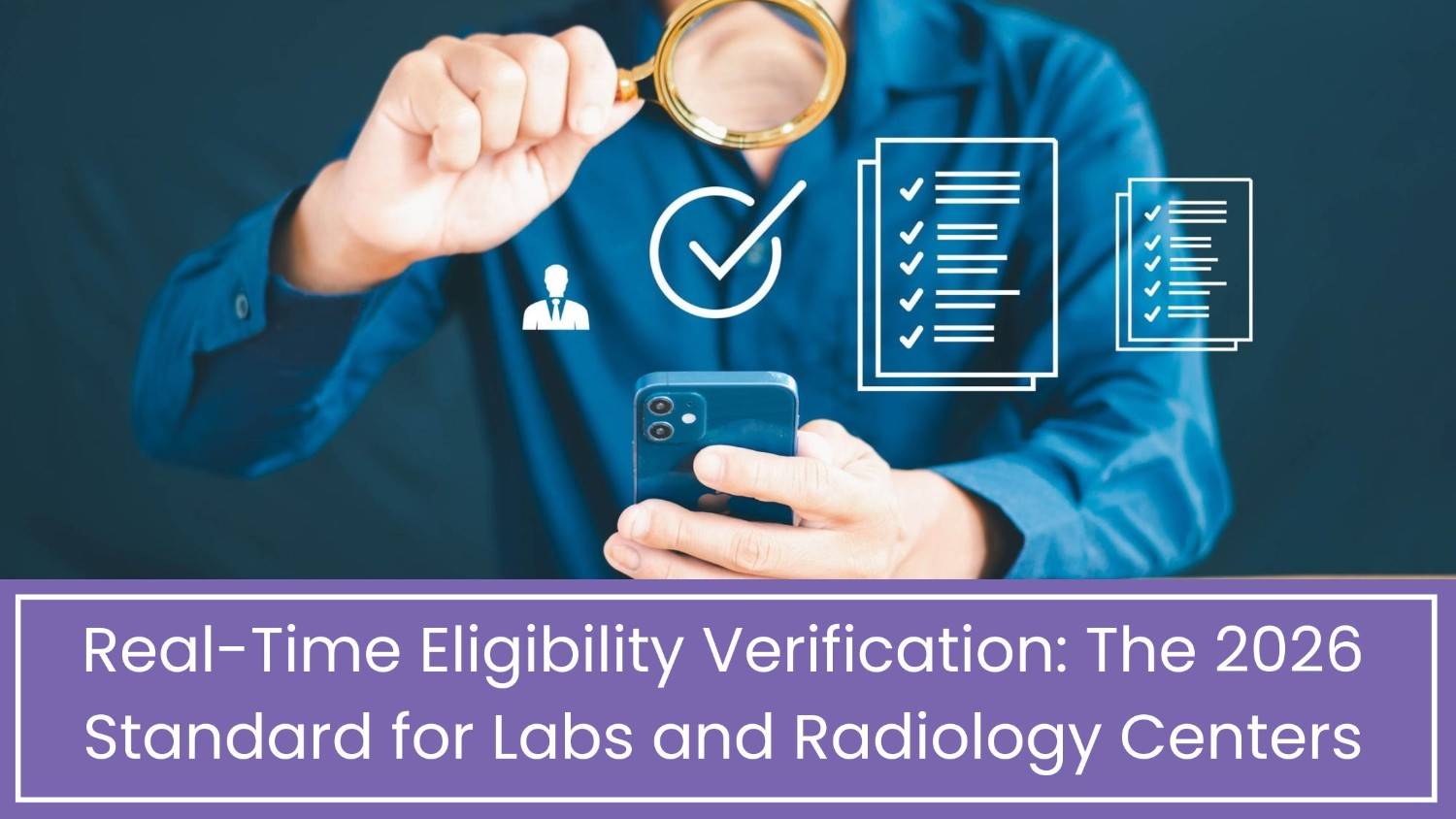
Real Time Eligibility Verification for Labs and Radiology
If you’re running a lab or imaging center, you already know the frustration of performing a test only to discover later that the patient’s insurance wasn’t active or a pre-authorization wasn’t secured. That’s revenue you’ll never recover. Real Time Eligibility Verification for Labs and Radiology is changing that story — preventing lost payments before they happen and ensuring every test begins with verified coverage.
Table of Contents
1. Why Labs and Radiology Centers Get Hit the Hardest
Labs and radiology groups sit right in the crosshairs when it comes to eligibility errors. You deal with high-cost tests, frequent healthcare prior authorizations, and constantly changing payer rules.
So when a coverage check slips through the cracks, the financial fallout isn’t small — it’s hundreds or even thousands of dollars per test. Multiply that by a week’s worth of orders, and you’re staring at a serious dent in your cash flow.
The tricky part? Many centers still rely on manual checks — someone calling a payer or logging into multiple portals. It’s slow, easy to overlook, and often too late.
By 2026, both CMS and private payers are making it clear: real-time eligibility verification needs to be built into every step of your billing workflow. It’s not just about compliance; it’s about protecting the revenue you’ve already earned.
2. What Real-Time Eligibility Actually Gives You (and How to Use It)
Real-time eligibility (RTE) connects your EHR or medical billing system directly with the payer — pulling back live coverage data in seconds. No waiting on hold. No guessing.
A single RTE check tells you:
- If the patient’s plan is active today
- What plan and payer you’re billing under
- How much deductible is left
- Whether pre-authorization or referrals are needed
- Any limitations or exclusions on the ordered test
The power of RTE isn’t just getting the info fast — it’s knowing how to act on it.
Let’s say an MRI shows “authorization required.” Your team knows immediately to route it to pre-cert before scheduling. Or if a patient hasn’t met their deductible, your front desk can discuss estimated costs upfront instead of sending a surprise bill later.
That’s how you turn billing from reactive cleanup into proactive prevention.
3. Bringing RTE into Your Front-End Workflow
To make real-time eligibility truly work, it has to happen early — at the front end, not after the claim is created.
Here’s what that looks like in a simple, real-world workflow:
Step 1: When You Get the Order
As soon as the referring doctor sends the order, your appointment scheduling system should automatically trigger an RTE check. If there’s no active coverage or an authorization is required, your team can handle that before the appointment is confirmed.
Step 2: Handle Pre-Auths Early
When the RTE response says “auth required,” don’t wait. Send it straight to your pre-cert team. Some labs even connect this with automated prior-auth tools to get faster turnaround times.
Step 3: Talk Money with Patients — Upfront
Once coverage is confirmed, your staff can discuss copays or deductible amounts clearly with patients. No awkward phone calls weeks later saying, “You owe us $250.”
Step 4: Recheck on the Day of Service
A quick RTE check on the date of service ensures nothing changed — because yes, sometimes patients switch plans midweek without realizing it.
That’s it. Four simple steps that save your team hours of rework and protect your margins.
4. Making the Tech Work: EHR Integration Tips
RTE sounds high-tech, but it’s mostly about connecting the right systems.
Here’s what matters most:
API Connectivity
Most EHRs now offer direct API connections to clearinghouses or payers. These APIs securely fetch eligibility data in real time. Ask your advancedMD EHR vendor or RCM partner if your current system already supports it — many do.
Batch vs. Single-Call Checks
- Single-call: Runs one patient at a time — great for smaller clinics or walk-ins.
- Batch: Runs all scheduled patients for the next day in one go — perfect for busy imaging centers.
A hybrid model works best: batch checks overnight, single-call checks for same-day adds or walk-ins.
When the System Fails (and It Sometimes Will)
Always have a manual backup process. If RTE fails to return data, your team should know exactly where to go — payer portals or call centers — without delaying care.
Simple Decision Flow Example:
Order Received → Run RTE
│
├── Coverage Active → Check if Auth Needed
│ ├── Auth Required → Send to Pre-Cert
│ └── No Auth Needed → Schedule
│
└── Coverage Inactive → Notify Patient / Reschedule
This keeps everyone on the same page and avoids “we didn’t know” moments.
5. Measuring the Impact: The KPIs That Matter
Once RTE is live, you’ll see improvements quickly — but it helps to measure them.
Here are the key numbers to watch:
- Denials: Expect a 35–50% drop in denials tied to eligibility or authorization errors.
- Collections: Practices often see 20–30% more collected upfront because patients know what they owe.
- Days in A/R: Faster eligibility = faster clean claims = quicker payments.
- Staff Efficiency: Your team spends less time chasing payers and more time serving patients.
- Patient Satisfaction: No surprise bills, fewer delays, better transparency.
In short, it’s one of those rare wins that helps both your bottom line and your patients.
A Quick Real-World Example
One imaging center in Texas rolled out batch RTE checks for all MRI and CT orders. Within 90 days:
- Eligibility-related denials dropped by 42%
- Staff time spent on phone verifications fell by 60%
- Days in A/R went from 42 to 28
Their billing lead put it simply:
“We didn’t realize how much money we were losing to bad eligibility until we saw the daily RTE reports.”
The 2026 Reality: RTE Isn’t Optional Anymore
CMS and most major payers are now aligning around real-time data exchange standards. By 2026, RTE will be expected, not optional.
That means every lab and radiology center should have:
✅ Automated eligibility checks at scheduling
✅ Built-in prior-auth routing
✅ Patient responsibility estimates before service
✅ Integrated API connections to payers
If you get these right now, you’ll be miles ahead when compliance rules tighten.
And honestly, even without mandates, RTE just makes sense — it’s faster, cleaner, and keeps you from doing work you’ll never get paid for.
Final Thoughts
Real-time eligibility and benefits verification services aren’t just a tech upgrade — it’s a financial safety net for every lab and imaging center.
When you know a patient’s coverage and authorization status before running a test, you’re not chasing dollars later — you’re collecting smarter, sooner, and with fewer surprises.

ALSO READ – Understanding Eligibility and Benefits Verification: A Guide for Medical Practices
Talk to Medical Billing Expert Today — Get a Free Demo Now!