
Why HIPAA Compliance Matters When Choosing a Medical Billing Partner
Why HIPAA Compliance Matters When Choosing a Medical Billing Partner is the single question clinics must answer before sharing patient information. This is not compliance for the sake of paperwork—it determines whether protected health data is truly secure, whether your practice is at risk of penalties, and whether claim delays or denials could disrupt cash flow. Before signing any agreement, request proof: a signed BAA, evidence of technical safeguards, and documentation of ongoing HIPAA risk assessments in medical billing. Ask for audit reports and staff training records. If a vendor treats compliance as optional, avoid them—you are not outsourcing work, you are outsourcing liability.
Table of Contents
Is Your Medical Billing Partner Fully HIPAA Compliant
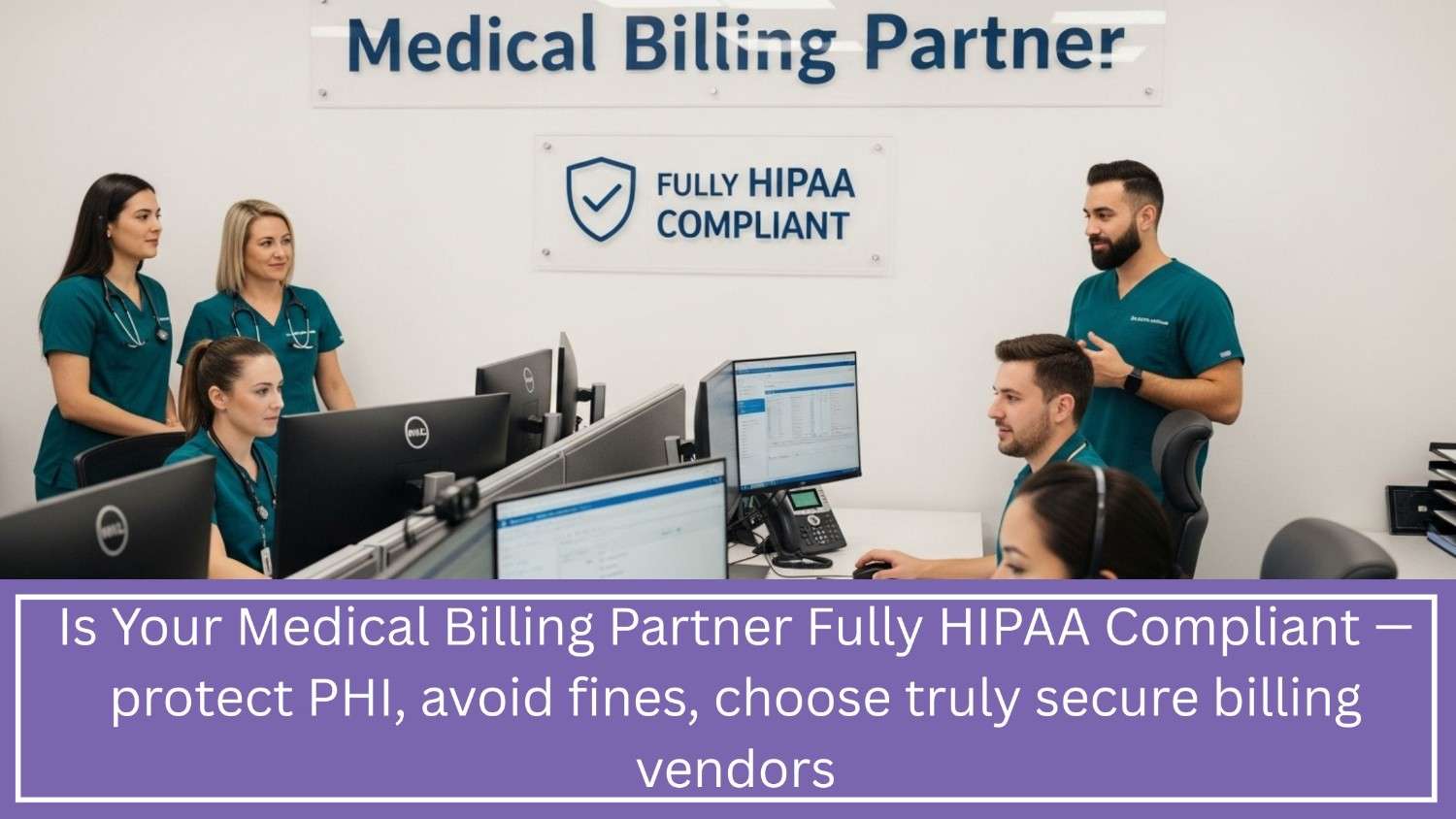
Let’s cut the fluff: giving a vendor access to Protected Health Information without a proper check is reckless. Is Your Medical Billing Partner Fully HIPAA Compliant isn’t a marketing line — it’s a checklist that protects your patients and your practice. A vendor’s glossy slides mean nothing unless you see operational proof: signed agreements, logs, audits, and live evidence of secure processes. If they can’t or won’t show that, assume the worst-case scenario and act accordingly.
Why HIPAA compliance in Medical billing Is No Longer Optional?
HIPAA enforcement is active, and fines are real. But even worse than fines are the day-to-day hits: investigations, patient notifications, reputational damage, and revenue disruption. If your vendor gets breached, your practice is the one handling patient questions and the regulatory fallout. Choosing HIPAA compliant medical billing services reduces that risk — and keeps your revenue cycle healthy. Outsourcing doesn’t remove regulatory responsibility; it transfers risk that you must manage.
What HIPAA Compliance Actually Means for Medical Billing Companies
Compliance isn’t a checklist you file away. It means:
- A signed, clear Business Associate Agreement (BAA).
- Demonstrable Medical billing HIPAA requirements compliance: documented policies, technical controls, and regular testing.
- Strong HIPAA data security for billing companies: encryption in transit & at rest, key management, access controls.
- Frequent HIPAA risk assessment medical billing and remediation tracking.
- Continuous employee training and updated procedures.
Ask for specifics: when was their last penetration test? Who holds encryption keys? How are privileged accounts audited? Vague answers are a deal-breaker.
Growing Trend: Data Breaches Linked to Billing Vendors
Third-party billing vendors are high-value targets. One vendor breach can cascade into dozens of affected practices. That’s why regulators and payers are increasingly scrutinizing outsourced medical billing HIPAA compliance. When a breach happens, claim processing often stalls, patient trust evaporates, and you end up paying for notifications, legal counsel, and potential fines. These are practical Medical billing compliance issues — and they hit every line of a practice’s P&L.
Role of Technology in HIPAA-Compliant Billing
Technology is only useful if implemented correctly. Good tech includes:
- End-to-end encryption and secure APIs.
- Multi-factor authentication and role-based access.
- Real-time logging and immutable audit trails.
- Automated monitoring tied to human review.
Demand vendors who advertise Secure Medical Billing Services to show the architecture and controls, not just buzzwords. Make sure automation is paired with HIPAA compliance audit services and human oversight — automation without governance is a liability.
How HIPAA Non-Compliance Impacts Revenue Cycle Performance
The combination of operational errors and unauthorized access and incorrect coding and late denial processing results in poor compliance. The result is increased rejections and extended accounts receivable period and decreased cash flow. A vendor who does not pass HIPAA Compliant Billing Vendors requirements likely engages in other unethical practices. The occurrence of breaches causes claims processing to stop while payers conduct investigations and your business loses revenue. The safeguarding of Medical Billing PHI protection directly impacts your financial success.
Practical Checklist: What to Audit This Week
- Signed BAA, proof of cyber liability insurance, and incident history.
- The recent HIPAA audit for medical billing companies requires SOC 2 or HITRUST reports when applicable.
- Billing companies must present HIPAA data security evidence through their encryption, MFA, access logs, and key controls.
- The Medical Billing Compliance checklist includes documented compliance requirements together with scheduled remediation deadlines.
- The organization conducted HIPAA risk assessment for medical billing operations and maintained records of all subsequent remedial actions.
- The organization provides proof of its quarterly Employee Training Program which includes training on HIPAA and phishing simulation exercises.
- The organization created a Formal Incident Response Plan which includes tested tabletop exercises.
If a vendor fails multiple items, slow down — or stop — the relationship.
Red Flags and Tough Questions to Ask Now
The vendor must provide specific details because their current response of “we’re working on it” and their refusal to show redacted audits should be treated as evidence of negative results. The organization needs to provide their designated security personnel together with their latest testing results and their intention to disclose summary results. The organization must stop sharing data when their employees refuse to comply with their requirements.
Human Factor: Training and Culture
Security needs both technological solutions and human resources for effective protection. The training schedule needs to be assessed together with information about employee onboarding procedures and background verification process and the methods used to implement organizational policies. The implementation of a solid Employee Training Program for HIPAA requirements leads to decreased security breaches and enhanced vendor trustworthiness..
Key compliance terms to verify (say them out loud during vendor calls)
- The organization requires its medical billing operations to demonstrate HIPAA compliance through operational testing and log maintenance because the policy exists only as a document.
- The vendor must implement specific safeguards and procedures to meet the HIPAA requirements for medical billing operations. The rules that apply to medical billing companies under HIPAA regulations should be understood to determine which rules affect business associates and covered entities.
- The vendor category of HIPAA-compliant billing vendors requires you to request their certification documents and attestation statements. The latest audit results together with execution plans should be requested from medical billing companies during their HIPAA audit process.
- The internal checklist of the organization should be obtained so that a comparison can be made with your existing checklist. The organization should request information about the last assessment and the main risks which were identified during the HIPAA risk assessment for medical billing.
- The vendors of HIPAA compliance audit services should hire independent auditors to conduct their assessments while requesting them to provide complete assessment documentation.
- Medical billing compliance issues require you to provide past examples which show how your organization handled those issues.
- The medical billing process needs HIPAA compliance validation which requires you to demonstrate your shifted responsibilities and your vendor help you meet compliance requirements.
- The HIPAA compliant outsourced billing services require organizations to provide evidence of their secure operational procedures and employee training programs and their methods for handling security incidents.
- Secure Medical Billing Services require technical evidence to support their claims.
- Billing companies use HIPAA data security measures which include encryption key management and monitoring practices to protect sensitive information.
- The ultimate endgame of PHI protection in Medical Billing requires you to prove it through documentation and live tests.
FAQs
1.Do you have a signed Business Associate Agreement (BAA) ready for us?
Always demand a BAA before any PHI is shared. If it’s missing, don’t proceed.
2. How do you handle “End-to-End” data encryption?
Request algorithms, key management, and proof that encryption covers both transit and storage. Vague answers = no.
3. How often do you conduct internal HIPAA risk assessments?
At minimum annually — best practice is continuous monitoring with formal annual assessments and documented remediation.
4. What is your Employee Training Program for HIPAA?
Ask for cadence, materials, and proof of completion. Quarterly training and real simulations are ideal.
5. Do you have a formal Incident Response Plan for data breaches?
Yes should include containment steps, notification timelines, and tested roles. If not tested yearly, it’s inadequate.
Conclusion
Your billing partner must meet HIPAA standards because compliance with HIPAA regulations serves as an essential business requirement. The vendor selection process should function like underwriting because organizations need to verify vendor security controls while requesting proof of compliance and maintaining the authority to terminate their relationship. Medical billing organizations maintain patient trust and secure their revenue cycle through effective PHI protection methods. You should replace your vendor with another option if they fail to demonstrate ongoing compliance verification processes.

ALSO READ – Decoding CPT: Your Guide to Codes and Regulations 2024
Talk to Medical Billing Expert Today — Get a Free Demo Now!