
Why Billers Need Certified Coders for ICD-11
Why Billers Need Certified Coders for ICD-11: The 2026 ICD-11 transition will reshape every layer of the billing ecosystem—diagnosis mapping, claims submission, payer audits, and documentation standards. To protect reimbursement and avoid compliance fallout, experienced certified coders aren’t optional—they’re essential. This post breaks down what’s changing, why ICD-11 complexity outpaces ICD-10, and how specialist coders prevent denials, missed specificity, and costly rework. If your goal is clean claims, faster payments, audit readiness, and operational confidence during the switch, this guide shows the exact steps to get your billing team prepared.
Table of Contents
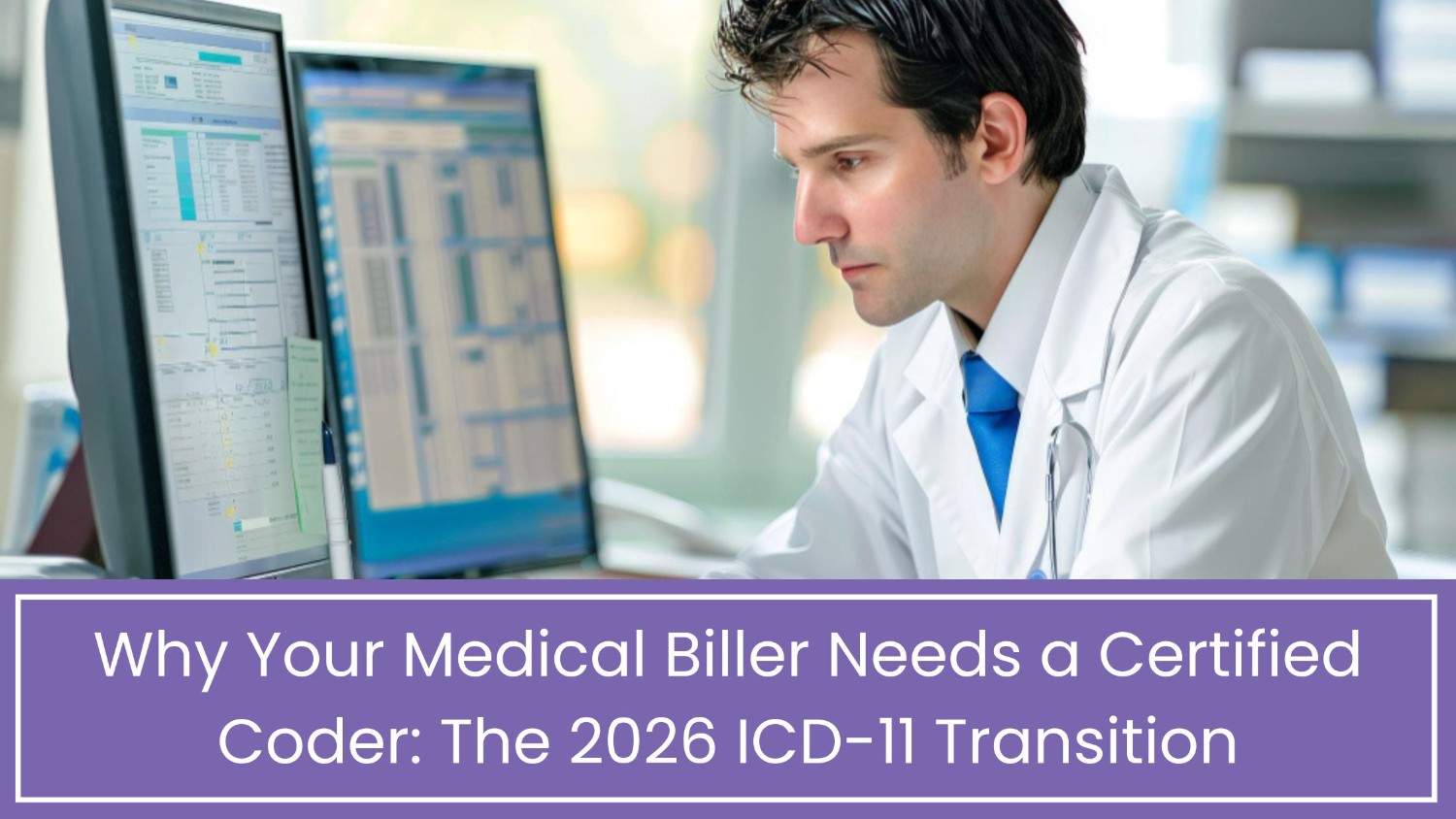
Why Your Medical Biller Needs a Certified Coder: The 2026 ICD-11 Transition
Medical billing isn’t easy. Each patient service requires precise coding for payment. Wrong codes cause denials, delays, or revenue loss. Now comes ICD-11—the largest coding shift in ten years. By 2026, most providers, EHR systems, and billing teams must adopt this new standard.
If your team isn’t prepared—or lacks certified coding expertise—your practice risks finances, efficiency, and trust.
This blog breaks down ICD-11 simply: what it is, why it counts, why certified coders are vital, and how to gear up before the deadline.
A Quick Hook — Why This Matters Right Now
- ICD-11 is a total rebuild—not just an update.
- It covers 17,000+ diagnoses versus ICD-10’s 14,000.
- Built as a digital toolkit, not a static list.
- Its “post-coordination” lets coders combine entries for complex cases.
- Major U.S. payers, researchers, and global groups want rollout by 2025–2026.
- While boosting care and reporting, it raises risks for untrained coders.
This is where certified expertise proves critical.
What Is ICD-11?
ICD stands for International Classification of Diseases.
This coding system tracks patient health conditions.
Businesses rely on ICD for billing, research, health monitoring, and insurance.
ICD-11 was designed to solve ICD-10’s problems. It brings key upgrades:
- Sharper medical descriptions
- Straighter organization
- Less puzzling groupings
- Digital-focused coding
- Codes fitting current illnesses and tech
- Smoother updates via online tools
In short, ICD-11 updates healthcare medical coding for better accuracy.
But here’s the catch:
Better tools mean tougher systems.
For clean billing, you need certified coders to prevent errors and revenue loss.
Why ICD-11 Changes Everything for Medical Billing
ICD-10 has been the U.S. standard since 2015. Teams invested years mastering it.
ICD-11 isn’t an update—it’s like trading flip phones for supercomputers.
The shift reshapes:
- Diagnosis recording
- EHR code retrieval
- Payer medical necessity reviews
- Claims submission processes
- Audit procedures
- Denial management
This isn’t a patch. It’s a total workflow rebuild.
If coders don’t know ICD-11:
- Claims get denied
- Payments run late
- Legal problems grow
- Audits happen more
- Records have mistakes
Certified coders fix these risks.
Why Your Medical Biller Needs a Certified Coder
Billing teams submit claims. Coders verify their accuracy. This distinction grows vital under ICD-11.
Trained coders grasp ICD-11’s framework
- Stem codes
- Extension codes
- Post-coordination
- Cluster coding
These are unfamiliar concepts. Uncertified billers face immediate confusion.
Coding mistakes will surge in 2026
ICD-11 brings deeper specifics.
But its complexity risks faulty coding.
Certified coders prevent:
- Misaligned diagnosis links
- Incorrect code extensions
- Missed diagnostic clusters
- Using outdated ICD-10 approaches
- Payment denials from incomplete data
Insurers will enforce stricter audits
As ICD-11 launches, payers will:
- Require precise clinical notes
- Scrutinize high-risk codes
- Match claims to medical necessity
- Reject vague or conflicting codes
Certified coders shield your revenue from these denials.
Audit risk climbs during system changes
Past proof? Clear:
- ICD-10 drove audit surges in 2015.
- Coding errors caused most claim rejections.
- Clinics bled cash that first year.
- ICD-11 will repeat this cycle.
Expert coders coach your team
They turn into your in-house advisors:
- Teaching billing staff
- Guiding doctors on notes
- Refining templates
- Coordinating with advancedMD EHR firms
- Adapting to insurer policies
- Scrutinizing risky claims
They anchor your revenue stream.
Stats Showing Why Certified Coders Matter
Here are the findings (industry data through 2025):
- 1 in 4 claims gets denied over coding mistakes.
- Providers lose 3-7% of yearly revenue from coding errors.
- Teams spend 15-20% of their time fixing bad claims.
- Certified coders make 30-40% fewer errors than uncertified staff.
- Automated audits find 50% more mistakes with trained coders guiding them.
- ICD-11 know-how lowers denials by up to 25% in trials.
These numbers prove certified coders pay off before ICD-11 launches.
ICD-11 Trends & News for 2025–2026
1. Global Gains: Over 35 countries already report with ICD-11.
The U.S. eyes a partial or full switch by 2026.
- Payers Prep: Insurers and Medicare test ICD-11 mapping now.
- Tech Timelines: EHR leaders plan ICD-11 tools for 2025–2026 launches.
- More states will require ICD-11
Some governments will adopt ICD-11 faster for health records.
5. AI coding tools are expanding rapidly
By 2026, 70%+ of big clinics will use AI-assisted coding.
6. Certifications, adding ICD-11 training
AHIMA and AAPC already teach ICD-11 basics in programs.
Every clinic must start preparing immediately—not later.
How ICD-11 Impacts Physicians & Clinical Documentation
Coders can only capture what doctors record. ICD-11 demands precision. Doctors must detail:
- Exact injury/illness locations
- How serious is it
- What caused it
- When it happened
- Related health issues
- Treatments provided
- Outside influences (like accidents)
Certified coders coach medical teams to prevent:
- Fuzzy notes
- Skipped facts
- Incorrect diagnoses
- Half-finished patient stories
Sharper records mean smoother billing.
The Cost of Not Having a Certified Coder During ICD-11 Transition
Using only basic billing staff causes four immediate problems:
1. More claim denials
Payers refuse unclear or wrong ICD-11 claims.
2. Costly rework needed
Claims ping-pong endlessly before approval.
3. Payment delays pile up
Tiny coding errors freeze payments for weeks.
4. Revenue bleeds out
Each denial costs cash to fix—or vanishes forever.
5. More compliance risks
ICD-11 may trigger audits due to:
- Wrong codes
- Extension errors
- Grouping mistakes
6. Higher team pressure
Your billing staff will struggle without expert support.
Certified coders fix these issues.
How to Prepare Your Practice for ICD-11
1. Bring a certified coder into your billing team.
If you don’t have one, hire or outsource immediately.
2. Check your top ICD-10 codes.
Spot which ones shift under ICD-11.
3. Train your staff ahead of time.
Don’t delay until 2026.
4. Update clinical note templates.
Help physicians capture clearer details.
5. Test ICD-11 with your EHR partner
Confirm seamless integration.
6. Monitor monthly claim denials
Identify trends fast.
7. Use AI coding tools with human review
Automation speeds the process—experts guarantee precision.
8. Create phased transition roadmap
Define stages:
- Training
- Audits
- Mapping
- Testing
- Go-live
Implementation success hinges on skilled coders.
A Simple Example: How a Certified Coder Reduces Problems
Imagine this:
A patient has type 2 diabetes, a foot ulcer, an infection, and nerve damage.
For ICD-10 coding:
- Use one primary code
- Add combination codes
For ICD-11 coding:
Build a cluster with:
- A stem code
- Extension codes
- Severity
- Site
- Cause
Key difference: ICD-11 requires grouping details instead of picking one code.
If your biller uses the wrong codes:
- Claims get rejected.
- Payers demand extra paperwork.
- Audit chances go up.
A certified coder nails it upfront – saves time, protects revenue.
The Bottom Line — ICD-11 Demands Skill, Not Guesswork
ICD-11 brings clearer billing, but it’s trickier.
Your billing staff shouldn’t tackle this solo.
Expert coders stop costly problems like:
- Refused claims
- Late payments
- Mistakes
- Rule-breaking
- Bad records
Your money health relies on spot-on coding for 2026.
Conclusion — How Practolytics Helps You Win the ICD-11 Transition
The ICD-11 change is major, but you’re not alone.
Practolytics makes your shift smooth with:
Certified ICD-11 coding experts
Our team knows the new rules and updates the codes correctly.
Full documentation help
We help your staff keep notes simple and complete.
Clean claims starting day one
Fewer mistakes. Fewer rejections. Faster money.
AI tools + human checks
The right blend for speed and accuracy.
Regular audits and ICD-11 prep
Stay compliant and avoid audits.
Clear dashboards and reports
Spot coding errors, denials, and claim issues.
Full billing help
Coding, claims, appeals—all handled smoothly.
Keep revenue strong in 2026: partner with experts!
Practolytics preps your team for ICD-11 with easy tools, expert coders, and smart workflows.
Get a free ICD-11 checkup now—shield your income before changes hit.
Be 2026-ready. Be Practolytics-ready.
ALSO READ – Decoding CPT: Your Guide to Codes and Regulations 2024
Talk to Medical Billing Expert Today — Get a Free Demo Now!