
Prior Authorization Services Companies in USA
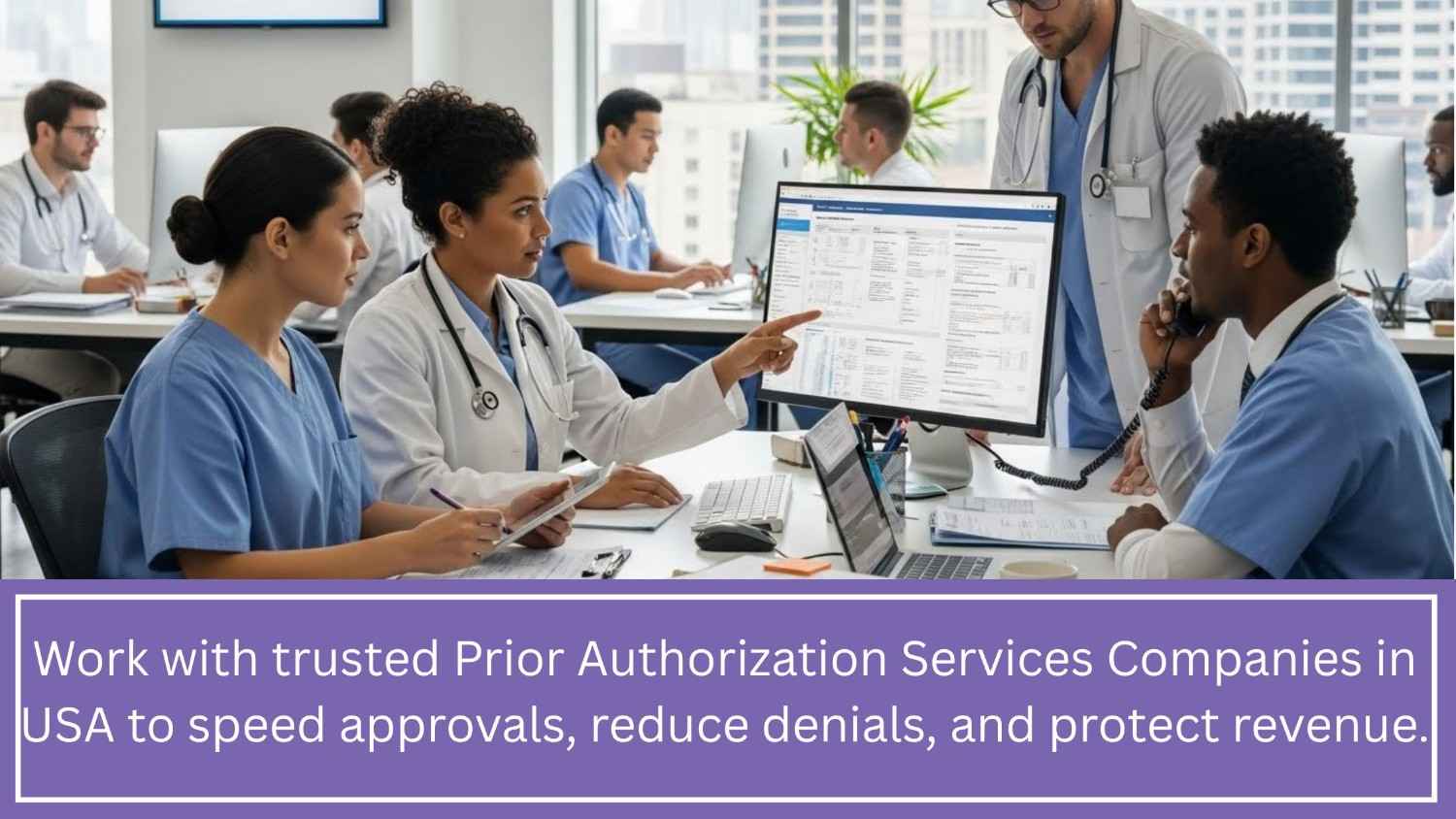
When prior authorizations slow down care, clinics lose revenue and patients lose trust. That’s where Prior Authorization Services Companies in USA step in — they handle the documentation, the payer follow-ups, and the appeals so your clinicians don’t spend clinic hours on phone trees. Whether you need Prior authorization services in the USA for a small specialty clinic or enterprise-wide Prior authorization outsourcing services in the USA, the right partner reduces denials, shortens approval times, and keeps compliance tidy. This piece breaks down how prior auth works, why it exists, the operational burden practices face, and what modern prior authorization management services in the USA actually do to fix the problem.
Table of Contents
Briefly Introduce Prior Authorization Services Companies in USA
Let’s start simple: prior authorization is the gatekeeper some insurers use to decide whether they’ll pay for a test, medication, or procedure. It’s a step that can protect payers from unnecessary costs — but in practice it often becomes a bottleneck that delays care, frustrates staff, and eats into revenue.
Prior Authorization Services Companies in USA specialize in managing that gatekeeper. They collect the clinical documentation, submit the request, follow up with payers, manage denials, and handle appeals. Some firms focus on volume and speed, others on clinical review and complex appeals. The common win? They take the time-consuming, brittle parts of prior authorization off your plate so your clinical team can see patients and your billing team can focus on cash, not chasing paperwork.
If you’re wondering whether to look into Medical Prior Authorization Services in the USA or “do it in-house,” think of it this way: if your staff spends more than a few hours weekly on prior auths per provider, you’re already paying a hidden tax on every visit.
Introduction to Prior Authorization Services
Prior authorization services are not just form-filling. A mature prior auth operation includes:
- Triage: deciding which requests are urgent, which are straightforward, and which need deep clinical backup.
- Clinical documentation assembly: pulling notes, imaging reports, prior treatments — everything payers want to see.
- Payer-specific rules: knowing exactly what evidence each insurer requires for the particular CPT/HCPCS/drug code.
- Submission and follow-up: tracking the request, nudging payers, and documenting every interaction.
- Denial management and appeals: writing peer-to-peer letters or escalating to medical directors when needed.
When you outsource to Prior authorization outsourcing services in USA, you ideally get all of that — plus reporting on approval times, denial reasons, and workload trends so you can actually improve processes rather than merely react.
Describe about Why Prior Authorization Exists in RCM Services?
In the revenue cycle, prior authorization exists primarily to control cost and utilization. That’s the payer’s side. For providers, the reality is different: prior auth is an administrative step that affects cash flow and patient experience.
Why does it matter for RCM?
- Payment predictability. An approved prior auth reduces the risk a claim is denied later for medical necessity. That’s cleaner AR and fewer write-offs.
- Order appropriateness. Payers argue prior auth keeps unnecessary testing down. If done smartly, it can align care with evidence.
- Upfront patient financial clarity. Some prior auths determine patient responsibility (e.g., whether a drug is covered under pharmacy vs. medical benefit), which affects collections.
So prior auth sits at the intersection of clinical decision-making and payment certainty. In modern revenue cycle prior authorization services, the goal is to convert that intersection from a choke point into a predictable step in the workflow.
Burden of Prior Authorization Services in Healthcare Market
Here’s the blunt reality: prior authorization is a heavy, unpredictable administrative burden.
- Staff time: Clinicians and nurses spend hours on calls or filling out forms. That’s expensive clinician time lost.
- Operational chaos: Different payers want different documents, different forms, and different submission portals. It’s a patchwork.
- Patient experience: Treatment delays frustrate patients and can harm outcomes — especially for high-cost medications or time-sensitive procedures.
- Financial leakage: Every delay risks a coding mismatch, a denial, or a missed appeal window. That’s cash left on the table.
The problem widens for specialties with high prior auth volumes — oncology, specialty pharmacy, durable medical equipment, certain imaging and interventional procedures. That’s why Prior auth services for healthcare providers exist: to centralize expertise, reduce turnaround time, and minimize the operational drag.
Role of Prior Authorization Service Companies in USA
So what do the good ones actually do? A capable Prior authorization Companies in USA will:
- Build payer rules libraries so each request is submitted right the first time.
- Offer clinical reviewers who understand specialty workflows and can assemble the exact documentation a payer expects.
- Provide dashboards that show pending requests, approval times, and denial reasons.
- Integrate with EHRs and scheduling systems to automate pre-visit eligibility checks and create worklists for authorization teams.
- Offer appeal services and peer-to-peer support for complex denials.
Companies that only “submit forms” are table stakes. The firms worth their salt deliver End to end prior authorization services in the USA — from pre-visit checks to receipts of payment — and tie their work to measurable revenue outcomes: improved approval rates, lower denials, better patient throughput.
If you’re shopping, insist on samples of their metrics: average approval time by payer, first-pass approval rate, denial reversal rate on appeal, and impact on days in AR.
Write about Technology and Innovation Trends
Technology is where prior auth becomes manageable instead of miserable.
Key trends to watch:
- Rules engines and payer libraries. Good platforms codify payer rules so the right evidence is requested automatically. That reduces back-and-forth.
- AdvancedMD EHR integration & automation. Automated worklists that pull necessary notes and labs reduce manual copy-paste and speed submission.
- Clinical decision support. Some advanced tools suggest alternate, quicker-to-approve therapies when clinically acceptable — saving time for both clinicians and patients.
- AI-assisted document assembly. Not to replace clinicians, but to pre-fill forms and highlight missing elements so humans can review faster. (Yes, it helps, but you still need clinical oversight.)
- Patient-facing portals. These let patients see authorization status and, when needed, provide consent or financial acknowledgement — improving transparency and collections.
- Analytics and root-cause identification. Modern vendors don’t just track approvals — they analyze why denials happen and fix upstream causes (e.g., order sets, documentation templates).
When evaluating Prior authorization solutions for providers, prioritize platforms that combine automation with real clinical expertise. Automation without clinical context is a brittle fix; clinical expertise without automation is just expensive labor.
Conclusion
Prior authorization is a reality of modern healthcare — messy, costly, and unavoidable for many specialties. The smart path is to lean on specialized partners: Prior authorization services in USA that combine clinical expertise with automation. Done well, these services protect revenue, speed patient access to care, and reduce the administrative load on your team. If your practice is wasting clinician hours on phone calls, seeing delays on critical therapies, or watching denials pile up, a thoughtful prior authorization management services in USA partner isn’t an optional expense — it’s a revenue-preserving necessity.
FAQs
How will we know the status of a pending authorization?
A reliable vendor provides a dashboard and regular status reports. You should be able to see pending requests, payer responses, and expected decision dates. Many partners also offer automated patient and staff notifications.
Does our staff still need to initiate the request?
Most partners will accept the initial trigger from scheduling or the EHR. Some practices prefer to have the clinical team initiate the request; others prefer the vendor to proactively run pre-visit checks and open authorizations automatically. Both models work; pick whichever fits your workflow.
What happens if a payer requests more clinical documentation?
A quality Medical Prior Authorization Services in USA provider has clinical reviewers ready to assemble additional records, write targeted clinical summaries, and escalate to peer-to-peer reviews if needed. Fast documentation assembly is the difference between getting timely approval and facing denials.
Are your specialists medically trained?
Top-tier Prior authorization Companies in USA staff clinical reviewers with nursing or advanced clinical backgrounds and provide physician-level oversight for complex appeals. Always ask for CVs or role descriptions during vendor selection.
How do you stay updated on changing payer policies?
Look for vendors that maintain live payer libraries, subscribe to payer bulletins, and invest in rules-engine updates. The best Insurance prior authorization services in USA teams track policy changes and push those updates into the submission workflows immediately.
Read More – Prior Authorization Services for Podiatry : improving Patient Access and Care
Talk to Medical Billing Expert Today — Get a Free Demo Now!