
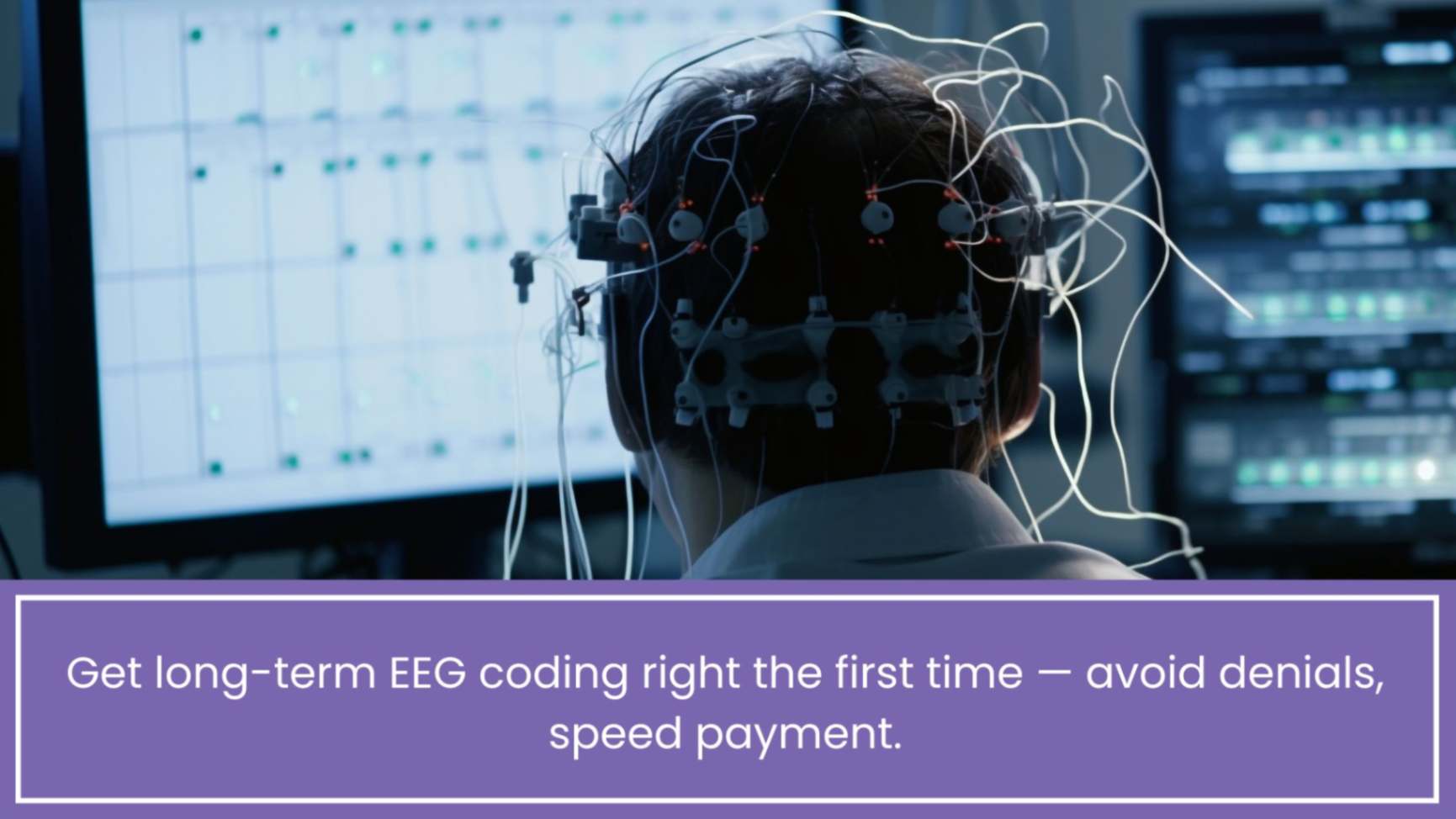
Long-term EEG CPT Codes
Long-term EEG billing is not the same as a routine brainwave study. The Long term EEG CPT codes family for long-term monitoring is built around duration, whether the study includes video, and whether the claim is for the technician/technical side or the physician/qualified health care professional side. CMS and AMA guidance split these services so the billing team can no longer guess from a single “EEG” label. That split is exactly why long-term EEG claims get denied when people treat them like a standard cpt for EEG or a generic cpt code for eeg routine.
Quick stats snapshot
|
Stat |
Why it matters for EEG billing |
Source |
|
About 2.9 million U.S. adults had active epilepsy in 2021–2022 |
Large patient pool means steady demand for long-term monitoring |
CDC |
|
42.6% of U.S. adults with active epilepsy reported fair or poor health |
These are often complex patients with more documentation sensitivity |
CDC |
|
38.4% of U.S. adults with active epilepsy reported a disability |
More disability status and chronic-care complexity can increase monitoring needs |
CDC |
|
CMS currently lists 55 ICD-10-CM codes supporting medical necessity for this EEG family |
Strong diagnosis matching is mandatory, not optional |
CMS |
Table of Contents
What Are Long-Term EEG CPT Codes and Why Did They Change in 2026?
They did not really “change in 2026.” That assumption is the problem. The major restructuring happened for dates of service on or after January 1, 2020, when CMS deleted the older EEG monitoring codes and added the 95700–95726 family, and AAN confirmed the new long-term EEG monitoring codes were effective January 1, 2020. In 2026, the bigger story is not a new code set; it is tighter payer scrutiny, medical-necessity enforcement, and fee-schedule pressure around neurophysiology services.
So when people search EEG CPT codes 2026, they usually want one of two things: a current code map, or a way to avoid bad claims. The honest answer is that the map is already established, but the billing risk is still high because the codes depend on exact timing and exact service components. 2026 education from neurophysiology groups still emphasizes medical necessity, documentation, and reimbursement pressure rather than a fresh code overhaul.
Documentation Requirements That Protect Every Long-Term EEG Claim
This is where most practices lose money. Medicare’s coverage article says ambulatory EEG should be preceded by a routine EEG, and that routine study must be documented within one year before the ambulatory continuous EEG claim. It also says the claim has to match the service performed, and only the component actually provided should be billed. That means the chart has to show the order, the indication, the start and stop times, the type of monitoring, and who actually performed which portion.
For professional reporting, the AAN recommends that the daily report include indication/history, technical details, exact start and stop times, baseline findings, interim findings, impression, and clinical correlation. AAN also makes one of the most important timing points painfully clear: time is continuous from the start of recording, and midnights do not reset the clock. That detail alone prevents a lot of incorrect unit counting.
A clean documentation packet should also make it obvious whether the service was unmonitored, intermittently monitored, or continuously monitored, and whether video was used. That is the difference between clean reimbursement and an avoidable denial. A practice that builds this into workflow, rather than trying to fix claims after the fact, usually spends less time on appeals. That is the kind of operational discipline practices often need from a revenue-cycle partner such as Practolytics, without turning the blog into a sales pitch.
Top 5 Long-Term EEG Claim Denial Reasons and How to Prevent Them
1. Wrong code family. A routine EEG code is not the same thing as a long-term monitor. If the record shows prolonged monitoring, video, or professional interpretation over multiple hours or days, the claim needs the long-term family, not a routine electroencephalogram CPT code from a short study.
2. Missing prior routine EEG. Medicare expects the routine EEG first for ambulatory EEG billing. No prior study, no clean claim.
3. Duration mismatch. Billers often choose the wrong bucket because they counted calendar days instead of continuous recording time. The clock does not reset at midnight.
4. Component mismatch. Billing both technical and professional work when only one was actually furnished is a fast track to denial.
5.Weak diagnosis support. CMS ties coverage to diagnosis coding, and the claim has to match the documented medical necessity.
To prevent those denials, lock in one internal rule: the note must answer who did the work, how long the recording lasted, whether there was video, whether the study was monitored, and whether the routine EEG prerequisite exists. That is more useful than memorizing random EEG billing codes without context.
Complete CPT Code Breakdown about 95700 Through 95726
Here is the practical version, not the confusing one.
|
Code group |
What it generally covers |
Practical billing note |
|
cpt code 95700 |
Technical start/setup for continuous EEG with video EEG tech involvement |
Treat this as the opening technical service, not the interpretation itself. |
|
cpt 95705, 95706, 95707 |
Technical long-term EEG without video, across 2–12 hours or 12–26 hours, with unmonitored, intermittent, or continuous monitoring |
Match the monitoring level and duration exactly. |
|
95711, 95712, 95713 |
Same duration buckets, but with video EEG monitoring |
Do not drop the video detail; it matters. |
|
cpt 95717, cpt code 95717, 95718 |
Professional/QHP code for 2–12 hours, without video or with video |
This is physician-side reporting, not the technical side. |
|
95719, 95720 |
Professional/QHP code for each 24-hour recording period, without or with video |
AAN notes these are reported for each 24-hour recording period. |
|
95721, 95722 |
Professional/QHP code for greater than 36 to less than 60 hours |
Use the right total-duration bucket. |
|
95723, 95724 |
Professional/QHP code for greater than 60 to less than 84 hours |
Again, duration drives the code. |
|
95725, 95726 |
Professional/QHP code for greater than 84 hours |
Highest duration bucket in the family. |
The phrase 95700 cpt code description is often searched by billers who want a shortcut, but there is no shortcut. It is a technical setup/start code, and the rest of the claim has to line up with the monitoring type and interpretation work. Likewise, 95717 cpt code description is not a synonym for every long-term EEG claim. It is one professional bucket inside a larger structure.
A lot of confusion also comes from the way people talk about the emu cpt code. EMU is a location and workflow concept, not a magic billing code. The actual claim still has to land in the correct long-term EEG family. If you work in an epilepsy monitoring unit, you still have to choose the right technical or professional code based on duration, video, and monitoring level.
How to Report Long-Term EEG Correctly
Start with the recording time, not the calendar. Then ask four questions in order: was there video, was the study monitored, did the physician/QHP have access, and is this the technical or professional side? That sequence keeps you out of trouble when choosing between cpt code 95716, cpt 95705, and the rest of the family. Time is continuous, so the start clock matters more than midnight boundaries or shift changes.
Then check the note structure. The report should include the order, reason for the test, EEG duration, daily findings if the study spans multiple days, and the final interpretation. When there is a routine study first, document it clearly and keep the date within the Medicare one-year window for ambulatory EEG. That single step can save a claim.
In real billing teams, this is where cpt code 95716 and cpt code 95717 get mixed up with the wrong duration buckets or the wrong component. The fix is not more guessing. It is a checklist, a code map, and a documented handoff between neurology, technologist, and billing teams. That is also why CPT for eeg work should never be treated like a quick data-entry task.
Conclusion
Long-term EEG billing is simple only for people who ignore the details. In real life, the claim depends on duration, monitoring type, video use, component split, and documentation quality. The biggest correction here is that the EEG cpt codes 2026 story is not a new code overhaul; it is a tighter compliance environment around an established 2020 code family. Practices that document cleanly, code by the actual service, and verify prerequisites will keep more revenue and spend less time on rework. That is where disciplined support and a clean workflow matter most.
1. What is CPT code 95700 used for in long-term EEG billing?
It is the technical setup/start of continuous EEG monitoring with video EEG tech involvement. It is not the physician interpretation code, and it should not be used as a catch-all for the whole study.
2. What is the difference between CPT codes 95705–95716 and 95717–95726?
The first group is technical monitoring codes, split by whether video is used and how the recording is monitored. The second group is the physician/QHP professional side, including initial 2–12 hour codes, per-24-hour codes, and longer duration buckets.
3.How do I choose between unmonitored, intermittent, and continuous EEG monitoring codes?
Use the way the study was really performed , not just assumed. If the technology or provider monitored continuously, go with “continuous”. If monitoring happened in intervals , like checking in at set moments, use “intermittent” instead. If there was no active monitoring happening in that specific category , then choose “unmonitored”. Also make sure the documentation actually supports whatever choice you make, because otherwise it doesn’t really hold up , you know?
4.Why did CPT codes for long-term EEG change in 2026?
They really did not materially change in 2026, but yeah, the big swing happened in 2020, when CMS replaced the older codes with 95700–95726. Now in 2026, there’s more pressure on the paperwork side , like documentation, medical necessity, and payer compliance, all together.
5. What documentation is required to support a long-term EEG claim?
You need the provider order, plus patient identification and the date time of service, the time length/duration, and the monitoring type. Also include what component got billed, and a report that sort of lays out the clinical findings and the impression, you know. For ambulatory EEG, Medicare still wants a prior routine EEG done within one year.
6. What are the most common denial reasons for long-term EEG claims?
Wrong code selection, missing prerequisite routine EEG, duration errors, component mismatches, and weak diagnosis support are the big ones. Most of these are workflow failures, not coding mysteries.

ALSO READ – Decoding CPT: Your Guide to Codes and Regulations 2024
Talk to Medical Billing Expert Today — Get a Free Demo Now!