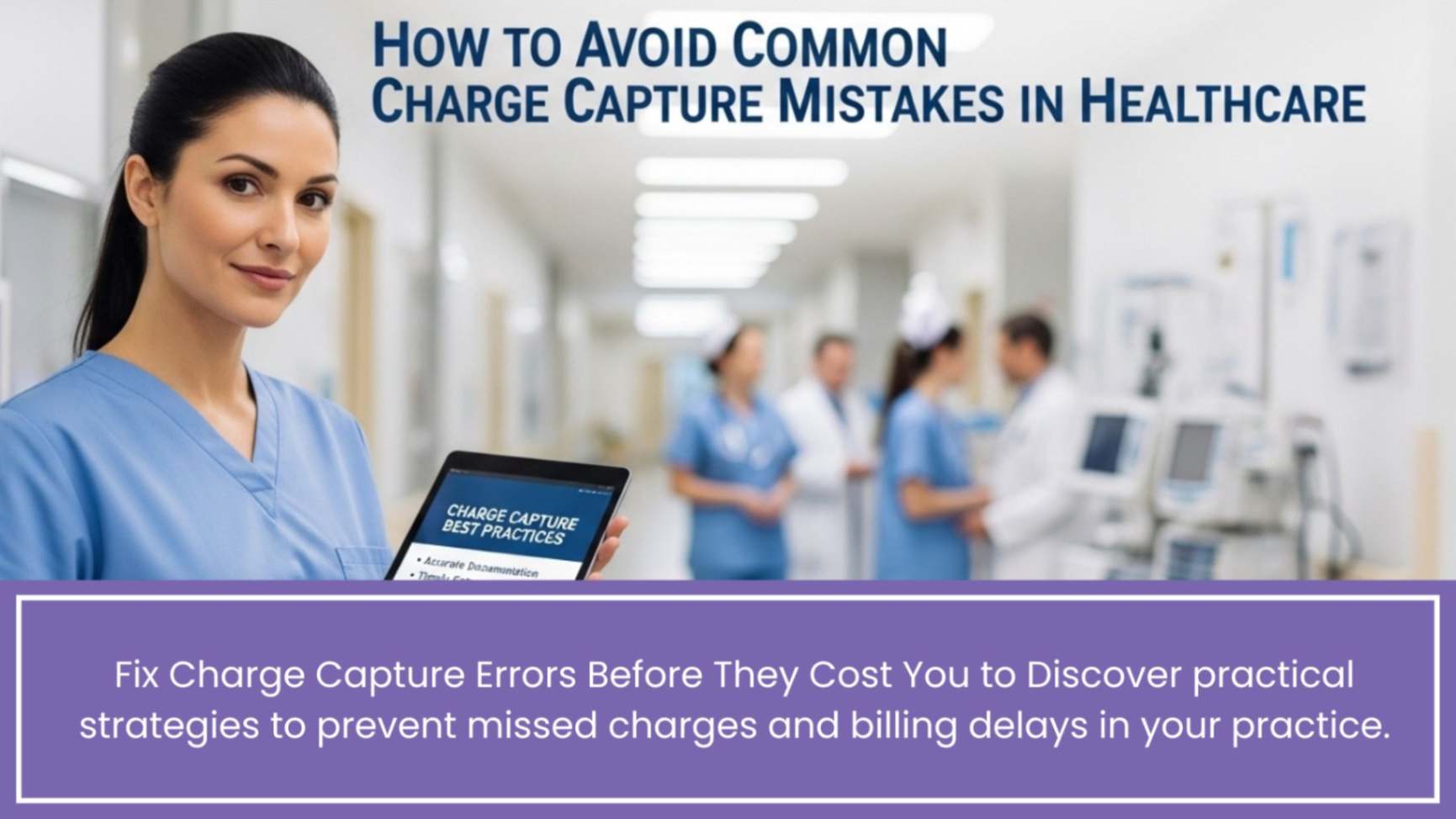
How to Avoid Common Charge Capture Mistakes in Healthcare
At Practolytics, we’ve worked with hundreds of practices across multiple specialties, and one issue keeps showing up: revenue leakage due to charge capture errors.
Understanding How to Avoid Common Charge Capture Mistakes in Healthcare isn’t just about billing. It’s about protecting your financial health, ensuring compliance, and building operational confidence.
Charge capture is the bridge between patient care and reimbursement. When that bridge has cracks, your revenue falls through.
Let’s fix that.
Table of Contents
Why Charge Capture Matters?
Charge capture ensures that every service provided to a patient is accurately documented, coded, and billed. If even small services are missed, incorrectly coded, or delayed, the financial impact compounds quickly.
Common symptoms of poor charge capture include:
- Rising denial rates
- Slower reimbursements
- High accounts receivable days
- Revenue that doesn’t match patient volume
Many practices assume these issues are payer-related. But often, the problem starts internally.
That’s why understanding Avoiding Common Charge Capture Mistakes in Healthcare is crucial for long-term sustainability.
Most Common Charge Capture Mistakes
Let’s break down the most frequent errors we see.
1. Coding Inaccuracies
Coding errors are one of the biggest drivers of denials and lost revenue.
These include:
- wrong CPT codes healthcare
- ICD-10 errors charge capture
- Upcoding risks avoidance
- Downcoding common pitfalls
- Modifier mistakes billing
Using incorrect CPT codes leads to underpayment or outright denials. Incomplete diagnosis specificity results in claim rejections. Providers sometimes downcode out of fear of audits, resulting in revenue loss. On the other hand, unintentional upcoding can trigger compliance scrutiny.
Modifiers are another major challenge. A missing or incorrect modifier can delay payment even if everything else is accurate.
2. Missed Charges
In busy environments, services get documented clinically but never make it to billing.
Common scenarios include:
- missed daily charge capture
- late charge entry problems
- end-of-day rush errors
- shift change capture gaps
- weekend charge oversights
- forgotten OR charges
- discharge delays billing
These mistakes are rarely intentional. They happen when providers chart late, when handoffs are inconsistent, or when workflows depend too heavily on manual processes.
3. Compliance and Structural Errors
Structural billing errors can create major financial and legal risks.
Examples include:
- Unbundling charge traps
- duplicate charges prevention failures
Unbundling services that should be billed together increases audit risk. Duplicate billing can lead to refunds, compliance investigations, and patient dissatisfaction.
Causes of Charge Capture Errors
Now let’s look deeper.
1. Workflow Gaps
Many practices lack standardized charge capture workflows. When processes vary by provider or shift, errors multiply.
For example:
- One provider enters charges immediately.
- Another waits until the end of the week.
- Nursing staff rely on memory for supply documentation.
These inconsistencies fuel late charge entry problems and shift change capture gaps.
2. Documentation-Coding Disconnect
When documentation lacks specificity, coding suffers. This leads to:
- ICD-10 errors charge capture
- Increased denial rates
- Lost risk adjustment revenue
Providers may document clinically accurate notes, but without structured templates, billable elements are often unclear.
3. Staffing Challenges
High turnover, limited coding training, and unclear accountability increase:
- end-of-day rush errors
- weekend charge oversights
- missed daily charge capture
Charge capture must be a team effort — not an afterthought.
4. Outdated Technology
Manual systems increase:
- Modifier mistakes billing
- duplicate charges prevention failures
- Missed alerts for billable procedures
Without automation, your team is relying on memory instead of safeguards.
High-Risk Departments for Charge Capture Errors
Some departments face higher risk due to pace and complexity.
1.Emergency Departments
Fast turnover increases:
- missed daily charge capture
- late charge entry problems
Documentation often gets completed after shifts, increasing error risk.
2.Operating Rooms
OR environments commonly experience:
- forgotten OR charges
- Supply documentation gaps
- Implant tracking inconsistencies
3.Inpatient Units
Frequent handoffs cause:
- shift change capture gaps
- discharge delays billing
4.Specialty Clinics
Complex coding structures lead to:
- wrong CPT codes healthcare
- Downcoding common pitfalls
- Upcoding risks avoidance
Each specialty needs customized monitoring.
Financial Impact of Charge Capture Errors
Even small errors have large financial consequences.
A consistent 5% charge leakage in a $5 million practice equals $250,000 annually. That’s significant.
Revenue loss stems from:
- Denials linked to ICD-10 errors charge capture
- Underbilling from Downcoding common pitfalls
- Refunds due to weak duplicate charges prevention
- Compliance exposure from Unbundling charge traps
Many practices only realize the problem when cash flow tightens.
Proactive monitoring is crucial.
Data-Driven Strategies to Avoid Charge Capture Mistakes
At Practolytics, we use structured systems and analytics to eliminate guesswork.
Here’s how we approach How to Avoid Common Charge Capture Mistakes in Healthcare.
1. Daily Encounter Reconciliation
We compare scheduled visits to charges entered daily. This prevents:
- missed daily charge capture
- late charge entry problems
- weekend charge oversights
No encounter should go unmatched.
2. Specialty-Specific Coding Audits
We routinely analyze trends in:
- wrong CPT codes healthcare
- ICD-10 errors charge capture
- Modifier mistakes billing
This ensures coding aligns with documentation and payer policies.
3. Real-Time Performance Dashboards
Data transparency reduces blind spots.
We track:
- Charge lag days
- Denial patterns
- Revenue per visit
- Coding correction rates tied to Downcoding common pitfalls
4. Structured Handoff Protocols
Clear shift transition protocols eliminate:
- shift change capture gaps
- end-of-day rush errors
Standardization drives consistency.
KPIs to Monitor Charge Capture Performance
If you want measurable improvement, monitor these indicators:
- Charge Lag Days
- Encounter-to-Charge Match Rate
- Coding Denial Rate
- Revenue Per Encounter
- Percentage of Corrected Claims due to wrong CPT codes healthcare
- Compliance flags linked to Unbundling charge traps
We also analyze recurring patterns in:
- duplicate charges prevention
- Upcoding risks avoidance
- missed daily charge capture
What gets tracked gets fixed.
Role of Automation and AI in Preventing Errors
Technology is no longer optional.
Automation helps reduce:
- Manual coding errors leading to ICD-10 errors charge capture
- Incorrect modifiers causing Modifier mistakes billing
- Overlooked services resulting in missed daily charge capture
AI tools can flag:
- Outliers indicating Upcoding risks avoidance
- Underbilling trends tied to Downcoding common pitfalls
- Patterns associated with Unbundling charge traps
At Practolytics, we integrate advanced automation into revenue cycle workflows to ensure:
- 24-hour claim submission
- Faster eligibility verification
- Reduced AR days
- Strong denial management
Technology should simplify, not complicate.
Practolytics Advantage
We don’t just identify errors — we fix root causes.
With 20+ years of RCM expertise, 5 million claims processed annually, and 1400+ active providers across 31 states, our team understands the complexity of modern healthcare billing.
We offer:
- End-to-end revenue cycle management
- Specialty-specific expertise
- Advanced automation tools
- Real-time analytics
- HIPAA-compliant systems
Our goal is simple: eliminate revenue leakage, ensure compliance, and maximize reimbursement without increasing provider workload.
When you partner with us, you gain visibility, structure, and peace of mind.
Conclusion:
Learning How to Avoid Common Charge Capture Mistakes in Healthcare is not about adding more documentation or overworking your team. It’s about improving workflows, aligning coding with documentation, leveraging automation, and using data intelligently. At Practolytics, we help practices reduce errors like wrong CPT codes healthcare, eliminate missed daily charge capture, prevent duplicate charges prevention failures, and avoid compliance risks from Unbundling charge traps. With structured processes and real-time insights, charge capture becomes accurate, predictable, and profitable — allowing you to focus on delivering exceptional patient care.
1.How can I avoid common charge capture mistakes in healthcare without increasing my documentation time?
Use structured templates, automated prompts, and daily reconciliation. These systems prevent missed daily charge capture without requiring extra time.
2.What are the most common charge capture errors doctors make during busy clinic days?
Common errors include end-of-day rush errors, wrong CPT codes healthcare, incomplete diagnosis specificity causing ICD-10 errors charge capture, and modifier confusion.
3.How can I ensure all billable services are captured accurately in my EHR?
Implement encounter reconciliation dashboards and coding audits to eliminate late charge entry problems and Modifier mistakes billing.
Why am I losing revenue despite seeing a high volume of patients?
High volume does not prevent leakage from Downcoding common pitfalls, duplicate charges prevention failures, or overlooked services.
4.How can I prevent missed charges for procedures performed during office visits?
Standardized visit templates and daily audits reduce forgotten OR charges and eliminate documentation gaps.
5.What role does documentation play in preventing charge capture errors?
Documentation is foundational. Clear, specific documentation reduces Unbundling charge traps, prevents denials, and ensures accurate reimbursement.

ALSO READ – Simplifying Revenue Management: How Medical Billing Services Empower Small Practices
Talk to Medical Billing Expert Today — Get a Free Demo Now!