
Healthcare RCM Services Companies in New Jersey
Running a healthcare practice isn’t only about treating patients, no. Providers also have to verify insurance, chase prior approval, submit claims, catch mistakes, do follow-ups with the insurance company, and then collect patient payments. When these things aren’t handled just right , payments start to crawl and unpaid claims kinda build up in the background.
That’s really where healthcare RCM services companies in New Jersey come in. They take care of the money side of patient care, from the first appointment until that last payment clears. For New Jersey providers working with Medicare, NJ FamilyCare, Horizon Blue Cross Blue Shield of New Jersey, commercial insurance plans, and even self-pay patients, an experienced billing team can cut down on errors and keep monthly income more steady and more predictable.
Table of Contents
Healthcare RCM Services Companies in New Jersey
Revenue cycle management, or RCM, is the process a healthcare provider uses to get paid for its services. It starts when a patient books an appointment. It ends when the provider receives the full and correct payment.
Healthcare revenue cycle management companies in New Jersey can handle tasks such as:
- Registering patients correctly
- Checking insurance coverage and benefits
- Getting prior authorization when required
- Entering medical codes and charges
- Preparing and submitting insurance claims
- Posting insurance and patient payments
- Correcting rejected or denied claims
- Following up on unpaid balances
- Sending patient statements
- Preparing financial reports
Not every company offers the same level of support. Some medical billing companies in New Jersey mainly prepare and submit claims. Full-service Medical RCM companies in New Jersey look at the entire payment process. They try to find out why money is being delayed, denied, underpaid, or missed completely.
Why RCM Matters for New Jersey Healthcare Providers
Getting a claim paid is rarely as simple as sending a bill. Every insurance company has its own rules. One may require prior authorization, while another may ask for additional medical records. A small mistake in the patient’s name, insurance number, medical code, or provider information can cause a claim to be rejected.
New Jersey providers also work with a wide range of insurance plans. These include Medicare, NJ FamilyCare Medicaid plans, Marketplace coverage, Horizon plans, employer-sponsored insurance, and self-pay patients.
The numbers below show why billing can quickly become difficult for New Jersey practices.
New Jersey Healthcare and Billing Statistics
|
Statistic |
Reported figure |
What it means for providers |
|
New Jersey acute care hospitals participating in QIP-NJ during 2025 |
58 |
Hospitals process large numbers of claims from different payers |
|
New Jersey Marketplace plan selections for 2025 |
484,540 |
Staff must check each patient’s current plan and benefits |
|
Average New Jersey Medicaid enrollment during FY2024 |
1.86 million |
Providers need experience with Medicaid and managed-care billing |
|
Prior authorization requests completed per physician each week |
About 40 |
Authorization work takes time away from patients |
|
Weekly time spent completing prior authorizations |
About 13 hours |
Manual insurance work places pressure on practice staff |
Reliable revenue cycle management services in New Jersey can help practices catch problems before the claim reaches the insurance company. This gives the claim a better chance of being accepted the first time.
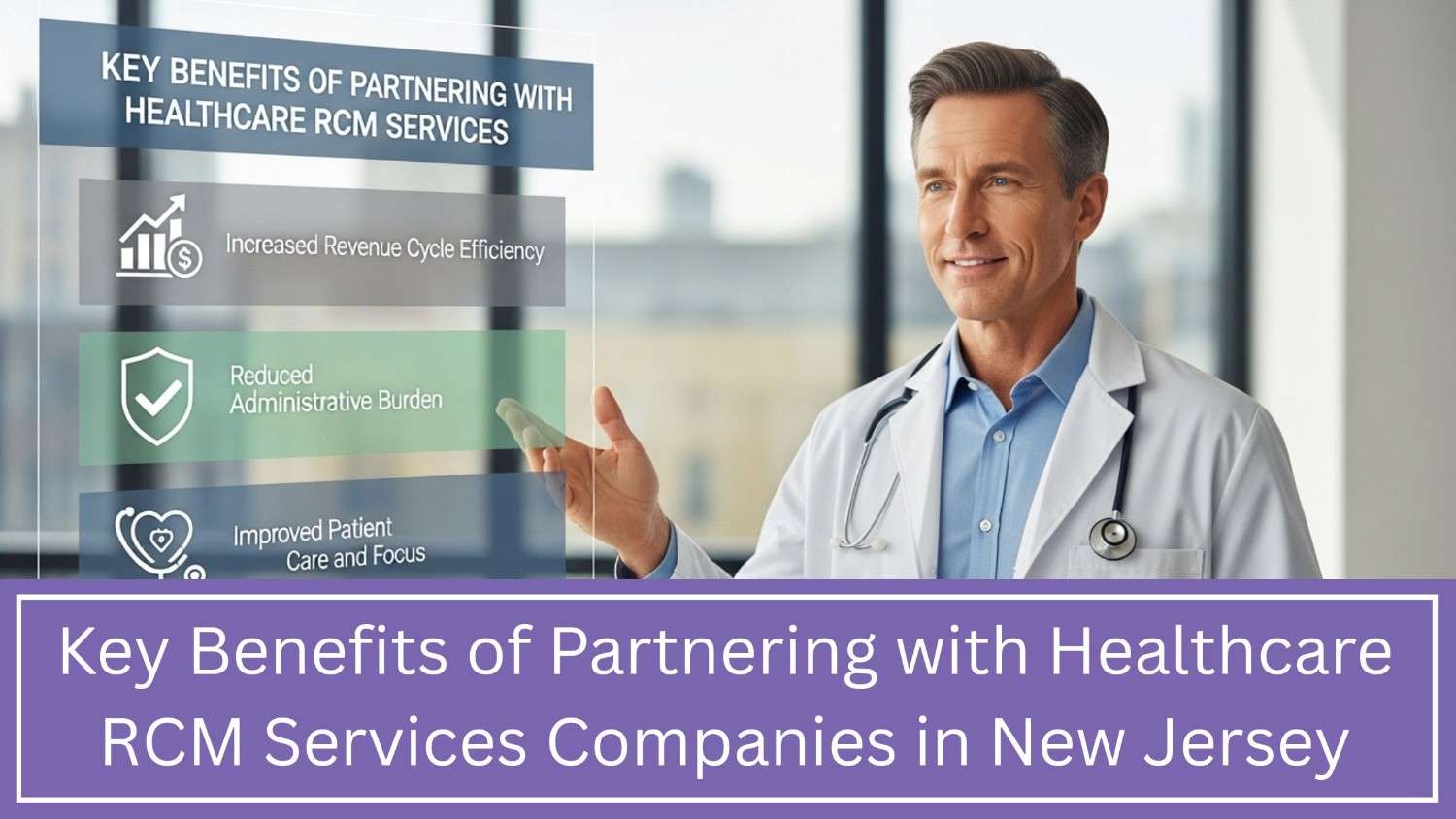
Key Benefits of Partnering with an RCM Company in New Jersey
A really good RCM company does more than just send claims. It kind of helps the practice, sort of understand where the money is stuck , and then what actually needs to change in real life.
Some key benefits look like this
- Fewer claim errors: Patient data, insurance details, and procedure codes, plus the supporting documents, are reviewed before anything is submitted.
- Better denial follow-up: When a claim gets denied, the problem is fixed, a formal appeal is filed if needed, and the whole thing is watched, so the same stupid issue does not repeat itself.
- Faster claim submission: Those completed visits get billed, with fewer avoidable waits or delays.
- Regular follow up: Unpaid claims are checked often, not just left alone for months.
- Clear financial Reporting: Providers can see what was billed, what was paid, what was denied, and what is still outstanding.
- Less pressure on employees: The front desk and clinical staff can spend more time on patients instead of chasing paperwork.
- Specialty-level Expertise: Skilled billers understand that cardiology, radiology, behavioral health , surgery, and primary care all follow different billing rules.
Good healthcare billing services in New Jersey should make billing easier to understand. If a provider cannot tell why claims are being denied or why payments are delayed, the reporting is not good enough.
Benefits of Hiring an RCM Company vs. Billing In-House
Keeping the billing “inside” the practice can give more direct control, though, it may also come with more stuff to manage. In practice the clinic still has to hire employees, train them , pay for the billing software, cover when people are out, and make sure everything stays in step with changing payer rules. Outsourcing cuts part of that effort, but it does not completely remove the responsibility the practice has to keep checking and reviewing performance.
|
Area |
In-house billing |
Outsourced RCM company |
|
Employees |
The practice hires, trains, and manages the team |
The RCM company manages its billing staff |
|
Staff absence |
Work may slow down when someone is unavailable |
A larger team may provide backup coverage |
|
Software |
The practice pays for and maintains the system |
Software may be included in the service |
|
Payer knowledge |
Depends on the experience of a small team |
May provide access to wider payer experience |
|
Growth |
More patients may require more employees |
Services can usually grow with the practice |
|
Cost |
Salaries, benefits, software, and training |
Percentage, monthly, hourly, or per-claim fee |
Medical billing companies usually take somewhere around 4% to 10% of what they end up collecting. i mean, that’s sort of an industry ballpark, not some fixed New Jersey number. the real total swings based on the specialty, the quantity of claims, how long the unpaid accounts have been sitting there and what services are actually included.
So when providers are comparing costs, they should really look at the full expense, not just the headline percentage. A smaller fee might sound like a win but it can turn into a bad bargain if denial appeals, coding, credentialing, or patient calls end up costing extra, and yeah that happens more than people think.
How to Choose the Right RCM Company in New Jersey
Many companies call themselves one of the best healthcare RCM companies in New Jersey. That is a marketing claim. It does not prove that the company is right for your practice.
Before choosing a provider, ask these questions:
- Does the company understand New Jersey payers?
Ask about Medicare, NJ FamilyCare managed-care plans, Horizon BCBSNJ, commercial insurance, and Marketplace plans. - Has it worked with your specialty?
A company that understands your procedures and common denial reasons will require less training. - What reports will you receive?
You should be able to see collections, denials, unpaid claims, old balances, and payment delays. - Who owns the billing data?
Your practice should be able to access and retrieve its information, even if the contract ends. - How does the company protect patient information?
Ask about HIPAA compliance, employee training, system access, and data security. - What happens during the transition?
The company should explain how it will manage old claims, new claims, payer access, and unpaid balances. - What is included in the price?
Find out whether coding, prior authorization, denial appeals, credentialing, reporting, and patient calls are included.
When comparing RCM providers in New Jersey and RCM vendors in New Jersey, ask for references from practices that match your size and specialty. A review from an unrelated type of practice may not tell you much.
Why Practolytics Is the Right RCM Partner for NJ Providers
Practolytics offers support throughout the revenue cycle, not only at the claim-submission stage. Its services include insurance verification, medical coding, claim submission, payment posting, denial management, unpaid-claim follow-up, credentialing, and financial reporting.
For providers comparing New Jersey healthcare billing companies, working with one team across the revenue cycle can make it easier to find the real cause of a payment problem.
For example, an unpaid claim may not be a follow-up problem. It may have started because the patient’s insurance was not checked, authorization was missing, documentation was incomplete, or the wrong code was used. Looking at the full process helps the billing team fix the cause rather than repeatedly correcting the same result.
Practolytics states that it has more than 20 years of healthcare technology and management experience. Still, providers should ask for clear pricing, relevant client references, expected transition dates, and measurable performance goals. No responsible company can promise the same results for every practice.
Providers searching for top medical billing companies in New Jersey or healthcare RCM firms near me should focus on experience, communication, security, reporting, and results rather than location alone.
Conclusion:
Choosing between RCM services companies in New Jersey should not be based only on price or marketing promises. The right company must understand your specialty, major insurance plans, current billing problems, and unpaid claims. It should explain how it works, pretty clearly… and still make sure it gives usable reports that show if collections, denials, and payment timing are getting better, or not, like month over month. Before anyone signs a contract, you should ask for a written transition plan, full pricing details, the data access terms (in writing), and references from similar practices. A dependable RCM partner can lower billing pressure, sure, but the tie up has to stay clear, measurable, and accountable.
1. What is the average cost of RCM services in New Jersey?
A lot of RCM companies want about 4% to 10% of what they collect for the practice, or so it goes. Some will do it per claim, some by the hour, and others go with a fixed monthly fee, it depends. The pricing seems to swing based on the specialty, how many claims come in, the age of unpaid accounts, and what services are wrapped in.
Before anything starts ask for a written quote that lays out clearly what you are paying for. Stuff like coding, credentialing, prior authorization, denial appeals, and patient calls might end up being billed separately, even if it feels like it should be all in one.
2. How long does it take to switch RCM vendors without disrupting cash flow?
A planned switch may take like four to eight weeks. If the practice is larger or more complicated, it might need longer, kinda beyond that range.
During the change, someone still has to handle the old claims while the new company starts up on current claims at the same time, even if it feels a bit messy. Software access, payer accounts, unpaid balances, reports, and patient information must get transferred carefully too. If you rush the switch it can really trip cash flow, so make sure you ask both companies for a written transition plan before anything happens.
3. Do RCM companies in New Jersey handle NJ Medicaid and Horizon BCBS claims?
A lot of companies do, but the providers really should confirm this beforehand, because once you sign, well then it can get sticky. Before anyone goes forward , ask if they have worked with NJ FamilyCare plans, Horizon BCBSNJ products, payer websites, prior authorization rules, claim filing deadlines , and the whole appeals process. Just saying they have general billing experience , does not automatically mean they understand every New Jersey insurance plan, not even close.
4. What’s the difference between medical billing and full revenue cycle management?
Medical billing usually covers coding, claim preparation, claim submission, payment posting, and follow-up.
Full RCM begins earlier. It may include patient registration, insurance verification, prior authorization, charge capture, medical billing, denial prevention, appeals, patient statements, collections, and financial reporting. In simple terms, medical billing is one part of the complete revenue cycle.
5. How fast can I expect to get paid after outsourcing RCM?
There is no fixed answer. Payment time depends on the insurance company, claim accuracy, authorization, medical records, coding, and the condition of the practice’s existing unpaid accounts.
A capable RCM company can reduce mistakes and follow up more consistently. However, it cannot control how quickly every payer processes a claim. Providers should track clean-claim rate, denial rate, and days in accounts receivable to see whether outsourcing is actually improving payments.

ALSO READ – Essential Tips for Error-Free Orthopedic Billing and Coding: Boost Your Practice’s Financial Health
Talk to Medical Billing Expert Today — Get a Free Demo Now!