

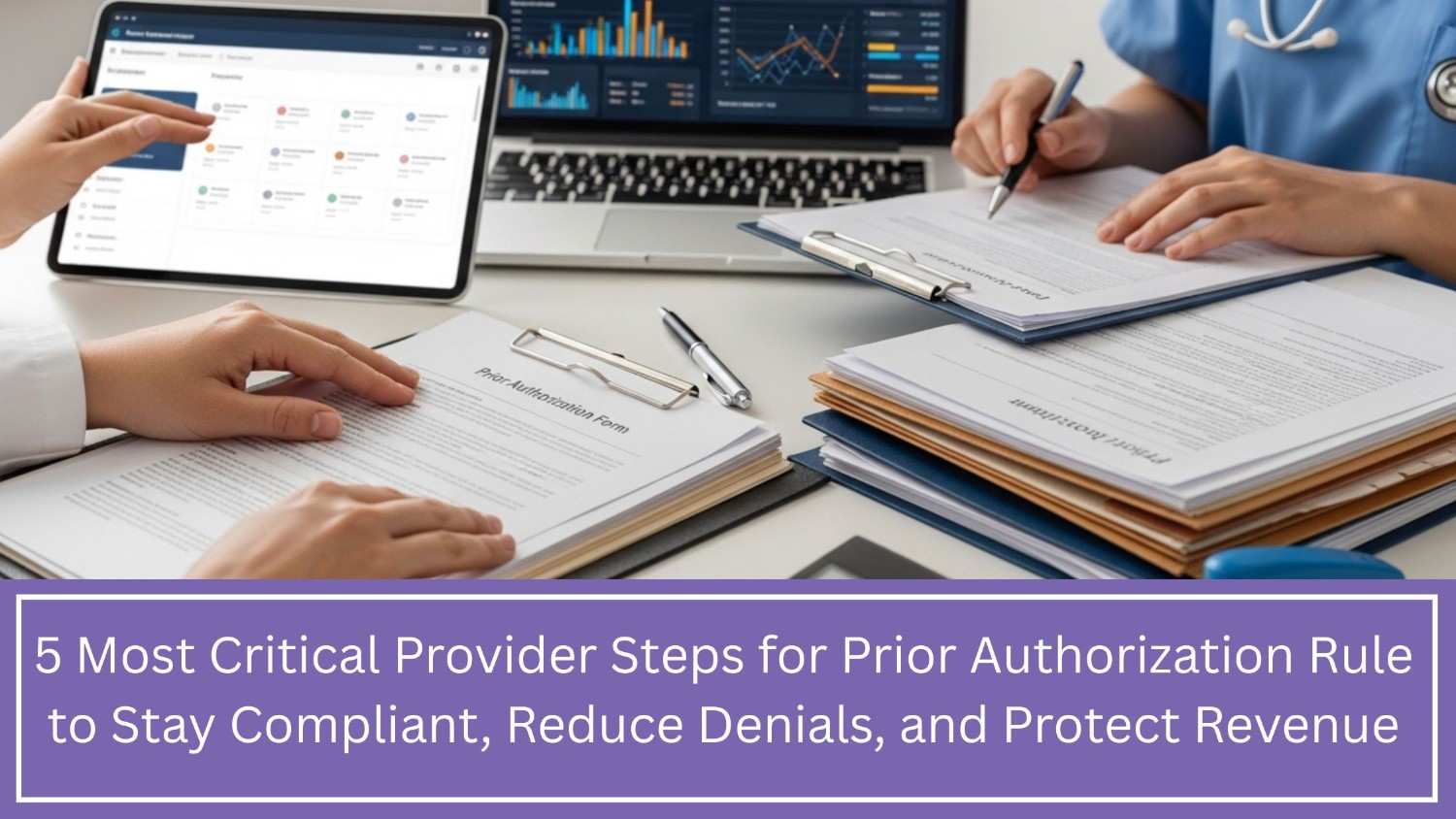
5 Most Critical Provider Steps for Prior Authorization Rule
The 5 Most Critical Provider Steps for Prior Authorization Rule have become mandatory requirements which provide predictable approval results and secure cash flow for your business operations. CMS has implemented stricter deadline requirements which necessitate electronic submission of documents while holding providers to higher standards of accountability. Yet many practices still rely on outdated workflows plus manual tracking methods which lead to incomplete documentation. At Practolytics, we observe three recurring issues which staff burnout and patient care delays create: denials which staff could have prevented. This guide presents a step-by-step processfor achieving compliance with prior authorization rule requirements through established effective procedures. No theory, no buzzwords—just practical steps to align workflows, meet deadlines, and reduce denials.
Table of Contents
5 Most Critical Provider Steps for Prior Authorization Rule
The process of prior authorization has transformed into an operational requirement which determines how healthcare providers achieve payment and how their patients access medical treatment. The 5 Most Critical Provider Steps for Prior Authorization Rule exist because the old approach—submit, wait, follow up randomly—doesn’t work anymore. Practolytics works with practices across specialties, and the reality is clear: providers who fail to adapt their practices will experience longer delays and higher denial rates while suffering increasing revenue losses. Successful organizations understand that prior authorization functions as a vital revenue cycle task which requires active management.
Why the Prior Authorization Rule Demands Immediate Provider Attention
The updated CMS framework has shifted responsibility squarely onto providers. The prior authorization rule CMS guidelines enforce faster response timelines, standardized electronic processes, and clearer communication expectations.
If your practice does not have a documented prior authorization rule compliance checklist, you are exposed. Non-compliance doesn’t always show up as penalties—it shows up as denials, rework, staff frustration, and delayed care.
At Practolytics, we often uncover broken provider prior authorization workflow steps that haven’t been reviewed in years. Requests are submitted late, documentation is incomplete, and no one tracks turnaround times. This is exactly why CMS introduced stricter oversight.
Ignoring these changes is not neutral—it actively damages your revenue cycle.
Enhance Patient Communication and Financial Transparency
Let’s be honest: most patient complaints around prior authorization come from silence, not denial.
Patients want to know:
- Does this need approval?
- How long will it take?
- What happens if it’s denied?
Clear communication is one of the most overlooked prior authorization best practices for providers. When practices proactively explain the process, patients are more cooperative, cancellations decrease, and billing disputes drop.
Transparency also supports prior authorization denial prevention strategies. Patients who understand timelines are less likely to abandon care or blame the practice for payer delays. This step doesn’t cost money—it saves it.
Transition to 72-Hour / 7-Day Submission Workflows
CMS timelines are non-negotiable:
- Urgent requests: 72 hours
- Standard requests: 7 calendar days
If your workflows aren’t designed around prior authorization turnaround time benchmarks, compliance is impossible.
Practolytics helps practices redesign intake so authorizations are identified at scheduling—not days later. This is foundational prior authorization workflow optimization.
Meeting these timelines consistently is one of the most effective steps to improve prior authorization approval rate. Late submissions invite denials, period.
Implementation of KPI Dashboards and Aging Queues
If your practice can’t answer these questions, you’re operating blind:
- How many authorizations are pending today?
- Which payers delay decisions the most?
- Where are denials coming from?
Tracking prior authorization performance metrics for practices is essential. KPI dashboards and aging queues highlight bottlenecks before they turn into denials.
This data enables real prior authorization process improvement guide execution, not guesswork. Practices that monitor metrics reduce rework, shorten turnaround times, and improve staff productivity.
Strengthen Documentation Before Submission
Incomplete documentation is the number one denial trigger.
Meeting prior authorization documentation requirements means more than attaching clinical notes. It requires payer-specific justification, medical necessity clarity, and accurate coding alignment.
Practolytics audits show that small documentation gaps drive most avoidable denials. Tightening documentation reduces prior authorization denials strategies and speeds up approvals without additional follow-ups.
Good documentation isn’t about volume—it’s about relevance.
Leverage Prior Authorization Automation Strategically
Manual prior authorization is expensive. Full stop.
Adopting prior authorization automation for healthcare providers reduces data entry errors, accelerates submissions, and improves tracking visibility. Automation is not about replacing staff—it’s about freeing them to handle exceptions and appeals.
Automation also supports electronic prior authorization requirements 2026, which will further limit manual and fax-based processes. Practices that delay automation will struggle to keep up.
This is one of the smartest prior authorization cost reduction strategies available today.
Financial and Clinical Impact of Prior Authorization Rules
Prior authorization failures hit twice—financially and clinically.
From a revenue perspective, delayed approvals stall claims and disrupt cash flow. The prior authorization revenue cycle impact is especially severe for high-cost services like imaging, procedures, and specialty drugs.
Clinically, delayed care frustrates patients and providers alike. Burnout increases when staff spend hours chasing approvals that could have been handled efficiently.
Strong prior authorization denial prevention strategies protect both care delivery and financial stability.
Conclusion
The 5 Most Critical Provider Steps for Prior Authorization Rule direct providers here to manage three specific aspects which include approval periods plus rejection decisions and financial income. Practices that standardize workflows together with documentation improvements and performance measurement and automation implementation achieve better results than practices which do not. At Practolytics, we see the difference every day. Prior authorization will never be enjoyable, but it can be manageable and predictable. Your practice will achieve faster approvals together with reduced denials and better cash flow when you treat the process as a strategic procedure instead of an administrative task.
FAQs
1. What are the most critical provider steps for prior authorization compliance?
They include standardized workflows, timely submissions, complete documentation, performance tracking, and payer-specific compliance using a prior authorization rule compliance checklist.
2. How can providers stay compliant with the new prior authorization rule?
Providers must align workflows with CMS timelines, adopt electronic submissions, track KPIs, and follow how to comply with prior authorization rule best practices.
3. What documentation is required under the updated prior authorization rule?
Clinical notes, medical necessity justification, treatment history, and payer-specific forms that meet prior authorization documentation requirements.
4. How does the prior authorization rule impact provider workflows?
It requires tighter timelines, clearer accountability, and optimized provider prior authorization workflow steps, increasing the need for automation and tracking.
5. What timelines must providers follow under the prior authorization rule?
Urgent requests must be processed within 72 hours, and standard requests within 7 days, per prior authorization turnaround time benchmarks.
6. How can providers reduce denials related to prior authorization?
By improving documentation accuracy, tracking denial trends, using automation, and applying proven reduce prior authorization denials strategies consistently.
Read More – Prior Authorization Services for Podiatry : improving Patient Access and Care
Talk to Medical Billing Expert Today — Get a Free Demo Now!