
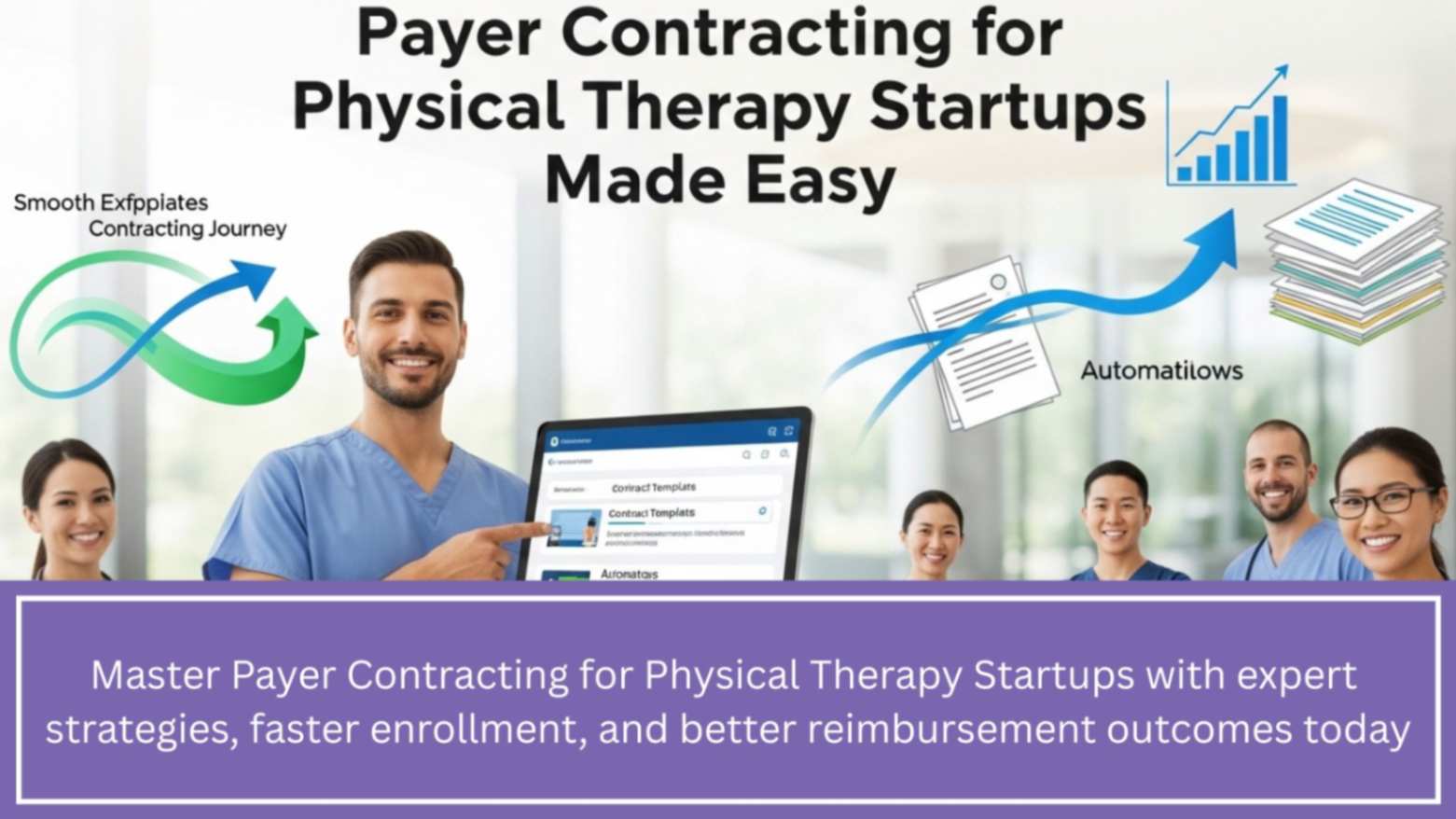
Payer Contracting for Physical Therapy Startups Made Easy
You can have the best therapists, modern equipment, and a steady flow of patients,but if your payer contracts are weak, your revenue will suffer.
That’s exactly why Payer Contracting for Physical Therapy Startups is one of the most crucial steps in your growth journey.
We’ve seen startups struggle with:
Delayed payments stretching beyond 60–90 days
Reimbursements lower than industry benchmarks
Constant claim denials due to poor contract alignment
At Practolytics, we step in early and fix this at the root using our physical therapy payer contracting services.
We don’t just help you sign contracts—we help you sign the right contracts.
And that includes everything from payer enrollment for physical therapy practices to optimizing reimbursement structures for long-term profitability.
Table of Contents
Why Payer Contracting Matters for Physical Therapy Startups?
Let’s break this down in a simple way.
Your payer contracts decide:
How much you earn
How fast you get paid
How many patients you attract
Real Impact on Your Revenue
A well-negotiated contract can increase your reimbursement by 20–35% compared to standard payer offers.
That’s not small. That’s the difference between surviving and scaling.
Key Benefits of Strong Contracting:
1. Higher Patient Volume:
Patients actively search for in-network providers. With proper in-network contracting for physical therapy, your clinic becomes more accessible.
2. Reduced Claim Denials:
Aligned contracts = fewer billing errors = faster payments.
3. Better Cash Flow Stability:
With optimized insurance contracting for physical therapy clinics, you avoid unpredictable revenue cycles.
4. Competitive Market Positioning:
Startups with strong contracts compete confidently with established clinics.
At Practolytics, we combine industry insights, analytics, and experience to deliver contracts that actually work for your business—not against it.
Understanding the Difference between Credentialing vs Contracting
This is where many startups get confused—and where revenue problems begin.
Let’s simplify it.
What is Credentialing?
Credentialing verifies who you are as a provider.
It includes:
License verification
Education validation
Background checks
This is essential for physical therapy insurance panel enrollment.
Without credentialing, you cannot bill insurance.
What is Contracting?
Contracting defines how you get paid.
It includes:
Reimbursement rates
Billing rules
Payment timelines
Denial conditions
This is the core of how to get insurance contracts for physical therapy startup.
Why This Difference Matters?
Here’s a real-world scenario:
You complete credentialing but accept poor contract rates
Result: You’re seeing patients—but losing money
You delay credentialing
Result: You can’t bill at all
That’s why we combine both through our physical therapy credentialing and contracting solutions.
At Practolytics, we handle both processes together to eliminate delays and maximize revenue from day one.
Reimbursement Rate Strategy for Physical Therapy Startups
Let’s get into the part that directly affects your bottom line.
The Biggest Mistake Startups Make
They accept the first offer from insurance payers. And that’s exactly where revenue leakage begins.
Our Data-Driven Strategy:
We approach physical therapy reimbursement contract negotiation with precision.
1. Market Rate Benchmarking:
We analyze payer rates across regions to ensure your contracts are competitive.
2. CPT Code Optimization:
High-volume procedures should bring higher returns—we ensure they do.
3. Payer Mix Strategy:
Not all payers are equal. We prioritize high-value contracts first.
4. Long-Term Profit Planning:
We look beyond initial rates to future scalability.
Real Insights:
Clinics that actively negotiate insurance contracts for physical therapy clinic improve profitability within the first 6 months. That’s the kind of impact strategic contracting can bring.
Negotiation Tactics for Physical Therapy Startups
Negotiation is not about pushing harder—it’s about positioning smarter.
Here’s how we do it:
1. Use Market Data as Leverage:
We present real numbers—not assumptions. This strengthens your position during physical therapy reimbursement contract negotiation.
2. Identify Payer Network Gaps:
If a payer lacks providers in your area, you gain leverage instantly.
3. Negotiate Beyond Rates:
Many clinics focus only on rates—but ignore:
Authorization timelines
Payment cycles
Denial conditions
We optimize everything.
4. Bundle Services Strategically:
Grouping services increases negotiation strength.
5. Use Expert Support:
This is where contract negotiation services for PT clinics become essential.
At Practolytics, we bring experience from 180+ practices and 28+ specialties to every negotiation.
Authorization and Utilization Management Clauses
Let’s be honest this is the part most physical therapy startups underestimate.
You might have great reimbursement rates on paper, but if your authorization rules are too strict or unclear, your revenue will still slow down. That’s why understanding authorization and utilization clauses is a key part of Payer Contracting for Physical Therapy Startups.
We’ve seen clinics struggle not because of low patient volume,but because approvals and documentation create constant delays.
Let’s break down the common challenges.
Common Challenges
1. Visit Limits:
Many insurance payers put a cap on how many therapy sessions a patient can receive.
At first, this may seem manageable. But in reality:
Patients may need more sessions than allowed
Clinics may need to request extensions repeatedly
Revenue becomes unpredictable
If these limits are not clearly negotiated during insurance contracting for physical therapy clinics, they can restrict your growth.
2. Pre-Authorization Delays:
This is one of the biggest bottlenecks.
Before starting treatment, many payers require prior authorization. If this process is slow:
Patient care gets delayed
Billing gets pushed back
Cash flow takes a hit
For startups, even a few delays can affect overall operations. That’s why aligning this step during payer enrollment for physical therapy startup is crucial.
3. Complex Documentation Requirements:
Every payer has different rules.
Some require:
Detailed treatment plans
Progress notes for every session
Specific coding formats:
If even a small detail is missed, claims can be denied.
This is where many clinics lose revenue without realizing it. Poor documentation alignment can undo even the best physical therapy reimbursement contract negotiation.
How We Solve It?
At Practolytics, we don’t just look at contracts—we focus on how they work in real life.
Here’s how we simplify things:
We streamline authorization workflows so approvals happen faster
We reduce delays by aligning payer requirements early
We standardize documentation to match payer expectations
We proactively track authorizations to avoid last-minute issues
Our approach ensures your physical therapy payer contracting services are not just theoretical—but practical and efficient. Because at the end of the day, a contract is only as good as how smoothly it runs.
Technology’s Role in Contract Optimization
Now let’s talk about something that makes a huge difference—technology.
Manual processes can slow everything down. Spreadsheets, emails, and follow-ups take time and often lead to errors.
That’s why we use technology to make payer contracting faster, smarter, and more predictable.
What We Do at Practolytics?
1. Real-Time Enrollment Tracking
We give you complete visibility into your payer enrollment for physical therapy startup.
You can:
Track application status
Identify delays early
Avoid unnecessary follow-ups
No more guessing where things stand.
2. Predictive Analytics
We don’t just collect data—we use it.
Our systems help identify:
Underperforming contracts
High denial trends
Revenue leakage points
This allows us to continuously improve your physical therapy credentialing and contracting strategy.
3. Automation:
We automate repetitive processes so your team doesn’t have to.
This includes:
Eligibility verification
Claims submission
Authorization tracking
Automation reduces human errors and speeds up the entire cycle.
4. Faster Turnaround Times:
With everything connected and streamlined:
Approvals happen faster
Claims move quicker
Payments arrive sooner
This directly improves your cash flow.
Real Impact
When technology and expertise come together, the results are clear:
Up to 30% faster reimbursements
Up to 25% reduction in claim denials
Improved efficiency across your entire revenue cycle
That’s the difference between just managing contracts and truly optimizing them. At Practolytics, we make sure your payer contracts don’t just exist—they perform.
Conclusion:
Getting payer contracts right is not optional—it’s essential for long-term success. With the right approach to Payer Contracting for Physical Therapy Startups, you can increase revenue, reduce denials, and scale confidently. At Practolytics, we simplify everything from physical therapy credentialing and contracting to advanced negotiation strategies and performance tracking. Our goal is simple—to help your clinic grow faster, operate smarter, and achieve consistent financial success while you focus on delivering quality patient care.
1.How do I negotiate better reimbursement rates with commercial payers as a new physical therapy startup?
Use data, local benchmarks, and demand insights. Partnering with experts in contract negotiation services for PT clinics improves outcomes significantly.
2.Which insurance payers should I prioritize when starting a physical therapy clinic?
Focus on Medicare, major commercial insurers, and high-volume regional payers based on patient demographics.
3.How long does payer credentialing and contracting typically take for a PT startup?
It usually takes 60–120 days depending on payer timelines and documentation accuracy.
4.What are the biggest mistakes physical therapy startups make during payer contracting?
Accepting low rates, ignoring contract clauses, and delaying physical therapy insurance panel enrollment are common mistakes.
5.How can I determine if a payer contract is financially viable for my clinic?
Evaluate reimbursement rates, patient volume potential, and denial risks before signing any agreement.
Talk to Medical Billing Expert Today — Get a Free Demo Now!