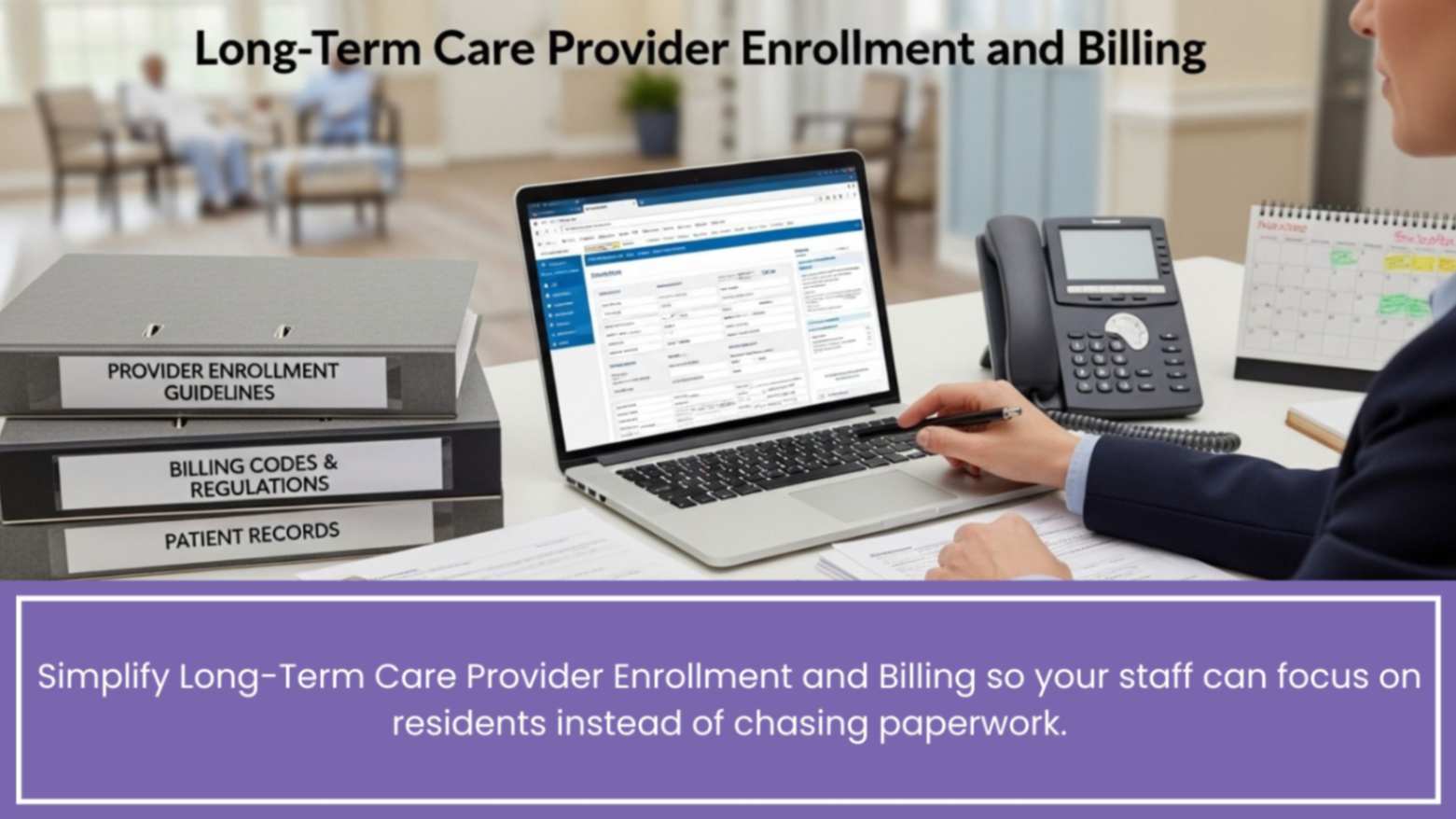
Long-Term Care Provider Enrollment and Billing
Enrollment and billing for long-term care providers are inextricably linked processes that encompass enrollment, credentialing, coding, claims submission, and reimbursement. Long-Term Care Provider Enrollment and Billing requires careful coordination to ensure providers meet payer requirements and receive timely reimbursement. Unlike many aspects of outpatient practice, long-term care organizations have to contend with skilled nursing facility (SNF) and nursing facility care, Medicare Part A and Part B claims, Medicaid reimbursement, and many payer requirements.
A single sign-up mistake can stop your payment. Also, wrong codes or poor notes slow down your cash flow and lead to increased accounts receivable (AR) days and denials.
A specialized partner can support the entire process, including:
- PECOS enrollment for long-term care providers
- CMS-855A enrollment
- Medicare enrollment for long-term care providers
- Medicaid enrollment for nursing homes
- NPI registration for nursing homes
- MDS and Section GG coding
- SNF consolidated billing
- Claims submission and denial management
For growing practices, pairing signup help with long-term care billing services keeps your cash flow steady and predictable.
CTA Button: Get Your LTC Billing Assessment
Table of Contents
What Is Long-Term Care Provider Enrollment and Billing?
Long-term care provider enrollment and billing requires two steps: first, secure your Medicare and Medicaid certifications; then, ensure every claim is submitted accurately to get paid.
Enrollment establishes the provider’s link to government plans and payers. Billing then turns resident services, practice notes, and coverage data into paid claims.
A comprehensive workflow may include:
- Medicare enrollment for long-term care providers
- Medicaid enrollment for nursing homes
- Long-term care credentialing services
- NPI and organizational information management
- PDPM (Patient-Driven Payment Model) billing
- MDS assessment coding
- UB-04 claim form preparation
- Per diem billing and case-mix calculations
- SNF consolidated billing
- Accounts receivable follow-up
The process keeps going after approval. Your team must keep payer data current, handle revalidations, and track every claim.
This means enrollment and billing are one single cycle, not separate office tasks.
CTA Button: Simplify LTC Enrollment & Billing
Why Enrollment Delays and Billing Errors Are So Costly for LTC Facilities
Long-term care centers need reliable revenue to pay staff, stock supplies, and keep things running smoothly every day. If forms are late or claims have mistakes, the revenue stays stuck for weeks or months.
The financial impact can appear through:
- Increased accounts receivable (AR) days
- Higher claim rejection volumes
- More manual claim rework
- Delayed Medicare or Medicaid payments
- Increased administrative costs
- Revenue leakage from underpayments or missed billing opportunities
Importantly, rejection of claims vs. denial involves different issues. In particular, rejection is a case when the claim is not accepted for processing due to some error, whereas denial is a situation when the claim is processed but the payer declines payment according to the submitted claim.
Enrollment problems lead to billing errors. If your data or dates do not match the payer’s records, clean claims will be denied.
Fixing your enrollment and billing early stops these glitches from hurting your cash flow.
CTA Button: Identify Revenue Cycle Inefficiencies
Understanding Long-Term Care Provider Enrollment
The nursing home provider enrollment requirements change based on who pays, your facility type, your city, and your care. Medicare needs your business info and some paperwork. Medicaid rules depend on your state.
Facilities may need to manage:
- PECOS enrollment for long-term care providers
- CMS-855A enrollment
- Organizational NPI information
- Ownership and management-control disclosures
- Licenses and certifications
- Medicare and Medicaid participation
- Payer credentialing
- Revalidation and enrollment updates
For organizations that operate in multiple states, multi-state Medicaid provider enrollment may create additional complexity, as each state’s Medicaid program may have its own applications, portals, documentation, and participation requirements.
Facilities must also monitor the long-term care revalidation process and update information in the case of ownership, location, accreditation, or other enrollment-related changes.
CTA Button: Review Your Enrollment Status
Long-Term Care Billing & Coding: What Makes It Different
Long-term care billing is not the same as a standard provider’s office. Nursing homes have their own rules for getting paid, based on patient needs, combined bills, and specific forms they must use.
Key areas include:
- PDPM (Patient-Driven Payment Model)
- MDS assessment coding
- Section GG coding
- Case-mix billing
- Per diem billing
- UB-04 claim form submission
- SNF consolidated billing
- Part A vs Part B SNF billing
- Medical necessity and documentation requirements
For SNFs, clinical assessments and documentation can directly affect reimbursement. Coding errors may therefore create more than a simple claim correction; they can affect the payment associated with a resident’s stay.
Facilities also need to know how Medicare billing works and which services they can bill for separately.
Expert skilled nursing facility billing services align your notes, codes, and rules to stop payment errors and protect your revenue.
CTA Button: Optimize Your LTC Billing
Denial Management in Long-Term Care Billing
Effective denial management starts before the claim is sent. Long-term care centers lose money because of wrong eligibility, enrollment gaps, coding errors, missing files, incorrect dates, or specific payer rules.
A strong denial management process should:
- Categorize denials by root cause
- Separate claim rejection vs. denial
- Prioritize high-value and time-sensitive accounts
- Review PDPM and MDS-related billing issues
- Correct documentation or coding problems
- Track payer response patterns
- Monitor recurring enrollment-related issues
- Follow up on outstanding claims promptly
Analytics can show where your denials start—whether it’s registration, coding, or claims.
The goal isn’t just to fight every claim. It is to find patterns and stop the same mistakes.
When denial management joins long-term care billing services, facilities stop fixing errors one by one and start fixing the root causes of revenue cycle inefficiencies.
CTA Button: Reduce LTC Claim Denials
In-House vs. Outsourced Long-Term Care Provider Enrollment and Billing
Managing enrollment and billing yourself works if you have a dedicated team and time. But for those running multiple sites, keeping up with payer rules, coding, and collections across every location becomes a struggle.
|
Area |
In-House |
Outsourced |
|
Enrollment monitoring |
Internal staff |
Dedicated specialists |
|
Multi-state Medicaid |
Can require multiple resources |
Centralized management |
|
Billing expertise |
Depends on staffing |
Specialized LTC team |
|
Denial management |
Internal workload |
Dedicated workflow |
|
Scalability |
Hiring-dependent |
Easier to scale |
|
Technology |
Existing systems |
Specialized RCM tools |
Healthcare RCM outsourcing keeps your cash steady without hiring more staff.
The best fit depends on your size, volume, tools, and unique workflow. If your AR days are piling up or claims keep getting denied, outsourcing is a smart way to fix your cash flow.
CTA Button: Compare Your RCM Options
Long-Term Care Billing Compliance Checklist
Compliance should be incorporated into every aspect of the long-term care (LTC) revenue cycle. Facilities must take responsibility for ensuring that the enrollment, clinical, coding, claims, and reimbursement LTC items are consistent with Medicare and Medicaid requirements.
A practical checklist includes the following:
- Verify active Medicare and Medicaid enrollment
- Monitor long-term care revalidation process deadlines
- Maintain accurate NPIs and payer records
- Review MDS assessment coding
- Validate Section GG coding
- Confirm PDPM calculations
- Check SNF consolidated billing requirements
- Validate Part A and Part B billing
- Review UB-04 claims
- Conduct periodic coding audits
- Monitor denials and payment variance
- Maintain appropriate CMS compliance
Regular audits stop small errors from becoming costly risks. Your team should track the fixes and train staff whenever the same error happens.
A billing process built for compliance secures your payments and lowers your financial risk.
CTA Button: Request an LTC Compliance Review
Why Choose Practolytics for Long-Term Care Provider Enrollment and Billing
Practolytics combines enrollment help, billing skills, coding checks, and cash flow tools to help long-term care teams get paid more reliably.
Our support can include:
- Long-term care provider enrollment and billing
- Medicare and Medicaid enrollment assistance
- PECOS enrollment for long-term care providers
- Credentialing and payer enrollment
- Claims processing
- Skilled nursing facility billing services
- MDS and Section GG coding support
- Denial management
- A/R follow-up
- Payment posting and reconciliation
- Clean claim rate monitoring
- Accounts receivable (AR) days tracking
For multi-facility groups, one shared process keeps work uniform and stops your team from wasting time on double entry.
Practolytics connects your billing to other healthcare RCM services, letting your team manage enrollment, coding, and collections in one easy step.
CTA Button: Partner With Practolytics
Final Thoughts
Successful long-term care provider enrollment and billing involve many more aspects than just submitting claims. Medicare and Medicaid enrollment and credentialing; MDS documentation and reporting; PDPM; consolidated billing; coding; denial management; and A/R follow-up, among others, are key components of proper and timely reimbursement for services rendered.
A strong LTC revenue cycle should:
- Keep payer enrollment current
- Prevent avoidable claim errors
- Maintain accurate MDS and coding practices
- Monitor denials and AR days
- Support CMS compliance
- Identify revenue leakage
- Create consistent processes across facilities
For organizations tired of messy administrative workloads, expert long-term care billing services help you fix your cash flow and make your income steady.
CTA Button: Get Your Free LTC RCM Assessment
Frequently Asked Questions
1. How long does long-term care provider enrollment take with Medicare and Medicaid?
There is no universal timeline. Enrollment in Medicare and Medicaid can depend on several factors such as the accuracy of the submitted application, the provider type, the state’s requirements, the payer’s workload, verification, and additional information requests. Therefore, long-term care providers need to ensure PECOS enrollment and the state’s Medicaid enrollment are up to date to avoid billing delays.
2. What documents are required for long-term care provider enrollment?
The requirements can differ for each program and state, and facilities may need to provide organizational information, NPIs, licenses, ownership and organizational information, tax information, accreditation or certification, banking information, and information on authorized officials. A nursing home provider enrollment requirements list can ensure that the required documents are prepared before submitting an application.
3. Why are long-term care claims being denied even after enrollment is approved?
Enrollment approval is not a payment guarantee. Claims can still fail due to bad codes, missing files, or wrong dates. Understanding why a claim was rejected versus denied helps you fix errors and collect your revenue faster.
4. What’s the difference between credentialing and provider enrollment in long-term care?
Credentialing generally means verifying a provider’s licenses, degrees, and certifications. Enrollment links that provider to a payer to ensure they get paid. These two steps often overlap, but they serve different business goals.
5. What is PDPM, and how does it affect long-term care billing?
PDPM (Patient-Driven Payment Model) is how Medicare pays for a patient’s stay in an SNF Part A. Classifications are based on patient characteristics, clinical features, and services provided within payment components. Correct documentation and coding of the MDS are accordingly important considerations, as errors may impact reimbursement.
6. Is billing different for skilled nursing facilities vs. assisted living communities?
Yes, skilled nursing facilities (SNFs) and assisted living are two distinct categories of healthcare organizations with different reimbursement policies and billing practices. Payment for skilled nursing services is covered by Medicare, while payment for services provided by assisted living facilities (ALFs) is primarily paid for through private pay and Medicaid, depending on the state of residence.
7. What are the most common billing errors in long-term care facilities?
Common issues like wrong patient data and billing mistakes lead to denied claims. Using audits to track these errors helps your team get paid faster and more accurately.
8. How can facilities avoid delays in Medicare or Medicaid revalidation?
Facilities must maintain an enrollment calendar, remind themselves of revalidation deadlines, keep ownership and organizational information updated, and be able to respond to payer requests. Maintaining the information up-to-date throughout the year will make the long-term care revalidation process much easier than searching for the required information before their deadline.
9. Can one billing partner manage enrollment across multiple states for a multi-facility LTC chain?
Yes, a single RCM partner can handle your Medicare and Medicaid sign-ups across many states. But since state laws vary, your partner must track local needs. A single strategy won’t work for every office location.
10. How do I know if it’s time to outsource long-term care provider enrollment and billing?
So, consider outsourcing if you miss enrollment dates, your billing team is stressed, your backlog grows, or you have too many locations to manage. Outsourcing your healthcare RCM needs can offer you the advantage of specialization without the need for each of your locations to have a dedicated staff.

ALSO READ – Simplifying Revenue Management: How Medical Billing Services Empower Small Practices
Talk to Medical Billing Expert Today — Get a Free Demo Now!