

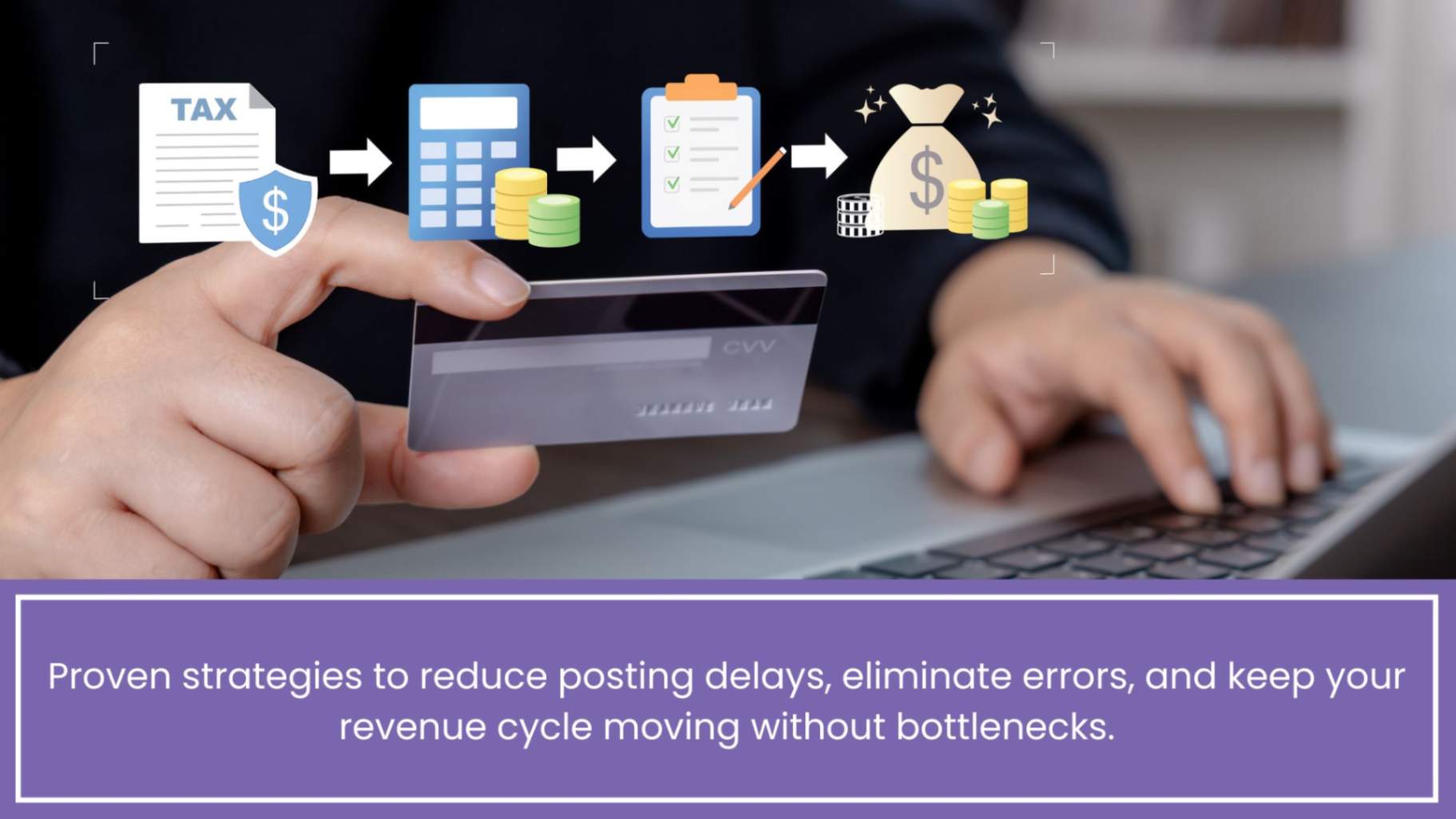
Strategies for Speeding Up the Payment Posting Process
Payment posting might seem like a pretty straightforward data-entry thing, but it actually tells the whole story of what happens next in the revenue cycle. Like, until a payment is posted in the right way, staff can’t really see if a claim was paid in full, only paid in part, denied, or just left hanging. The proper strategies for rushing the payment process help practices get payments on record sooner, spot those underpayments quicker, generate correct patient statements, and route denied claims to follow-up without delay.
And the point isn’t just to push through the queue faster. The goal is to shape a workflow that is quick, reliable, and simple to verify. Which means having automation in place, using standardized rules, doing daily reconciliation, training the team so it’s consistent, and keeping a direct linkage between payment posting and accounts receivable follow-up.
Table of Contents
Strategies for Speeding up the Payment Process
In healthcare, payment posting is basically the act of recording insurer payments and patient payments so they land on the correct claims . The posting team also logs contractual adjustments, deductibles, copays, coinsurance, denials, and zero pay remittances, even when it feels repetitive.
People who are researching how to speed up payment processing faster often zoom in on data-entry speed only , like it’s the whole story. But that view is incomplete. A payment can be posted quickly but if it is tied to the wrong patient or the wrong claim, it turns into extra work later, and that extra work is not small. Real payment process optimization usually tries to balance three things at once:
- Speed: How soon payments get posted after they arrive
- Accuracy: Whether the amounts and adjustments really match the remittance
- Action: Whether any unpaid balance gets routed to the right follow up team
Also, some phrases like “how to speed up checkout,” “faster checkout process,” and “reduce checkout time” show up more often in retail. In healthcare, they mostly relate to collecting copays and outstanding balances at patient checkout , not to insurance payment process optimization . So it shouldn’t be mixed up.
6 Proven Strategies to Speed Up Payment Posting
1. Use ERA and EFT whenever possible
Electronic remittance advice, or ERA, explains how the payer processed each claim. Electronic funds transfer, or EFT, sends the money electronically. Connecting both to the billing system reduces paper handling and manual entry.
This is one of the most reliable faster payment processing methods because clean ERA files can be posted automatically while only exceptions require staff review.
2. Post payments every business day
Waiting several days to post a payment hides the real status of the account. Use daily posting schedules for ERA files, checks, credit cards, lockbox payments, and patient portal transactions.
Daily posting improves payment workflow optimization and helps staff identify missing deposits before they become difficult to trace.
3. Create rules for automatic posting
Set system rules to match payments using the patient account number, claim number, date of service, payer, billed amount, and allowed amount. Rules should also recognize common contractual adjustments.
Automation can improve payment processing efficiency, but exceptions must still enter a manual review queue. Never allow the system to write off an unexplained balance automatically.
4. Separate clean payments from exceptions
Do not make staff review every transaction in the same way. Automatically post clean, fully matched payments. Route partial payments, duplicate payments, unidentified deposits, takebacks, and unusual adjustments to separate queues.
This approach provides a quick payment approval process without sacrificing accuracy.
5. Standardize zero-pay and partial-pay handling
A zero-pay ERA still contains important information. It may show a denial, missing authorization, coordination-of-benefits problem, or request for medical records. Partial payments may reveal bundling, downcoding, or an incorrect contractual adjustment.
Written work instructions help staff determine when to post, transfer, appeal, or escalate each transaction.
6. Reconcile postings with bank deposits
At the end of each day, compare the total posted amount with EFT, lockbox, check, credit card, and bank deposit totals. Investigate every difference.
Reconciliation is one of the simplest ways to improve payment processing speed because it catches problems while the records are still fresh.
Why Outsourcing Payment Posting Speeds Up Your Revenue Cycle Management?
Outsourcing can help when a practice has backlogs, staff shortages, inconsistent coverage, or large payment volumes. A capable RCM company can provide dedicated posting staff, extended processing hours, payer-specific knowledge, and clear exception queues.
However, outsourcing does not automatically fix a broken process. Before selecting a partner, define:
- Expected posting turnaround time
- Accuracy and reconciliation standards
- Escalation rules for partial and zero-pay claims
- Access controls and HIPAA safeguards
- Reporting frequency
- Responsibility for unresolved balances
The partner should also explain how to make payments faster without relying on inappropriate write-offs. For patient payments, tools that speed up online payment approval, securely save payment methods, and optimize the payment checkout flow can reduce friction. Practices can also reduce payment checkout steps by using mobile-friendly forms and clear balance information.
Financial Impact of Slow Payment Posting
Slow posting does not necessarily mean the payer paid late. It means the practice cannot use the payment information promptly. That delay can produce inaccurate AR reports, late denial follow-up, incorrect patient statements, missed underpayments, and poor cash forecasting.
MGMA’s July 2026 poll of 203 medical group leaders found that 32% had higher days in AR than one year earlier. MGMA also reported that denials and appeals were the largest source of revenue leakage for 48% of surveyed leaders. The AMA warns that delays in parts of the claim workflow can postpone payment for several months.
|
Published evidence |
Finding |
Why it matters |
|
MGMA 2026 poll |
32% reported higher days in AR |
Cash remains unavailable longer |
|
MGMA 2026 poll |
48% named denials and appeals as the largest revenue leak |
Posting must trigger rapid follow-up |
|
AMA revenue-cycle review |
Initial denial rates rose from 9% in 2016 to 12% in 2022 |
Denial identification cannot wait |
|
2025 CAQH Index |
Electronic transactions avoided an estimated $258 billion in 2024 administrative costs |
Automation can reduce manual work |
|
2024 CAQH Index |
$20 billion in additional savings remained available |
Manual workflows still create avoidable costs. |
Integrate Payment Posting with AR Follow-Ups
Payment posting and AR follow-up should operate as one connected workflow. As soon as a payment is posted, the system should classify the remaining balance.
For example:
- Full payment: Close the claim after reconciliation
- Partial payment: Compare the amount with the payer contract
- Zero payment: Send the denial reason to the appropriate queue
- Patient responsibility: Generate an accurate statement
- Missing payment: Begin payer follow-up
- Overpayment: Review before refunding or applying a credit
This connection prevents a denial or underpayment from sitting untouched. The AMA recommends verifying that insurance payments and adjustments are applied correctly before patient statements are sent.
Monitor Key Performance Indicators in Payment Posting
Track a small set of KPIs that show whether the process is both fast and accurate.
|
KPI |
What it measures |
Practical target |
|
Posting turnaround time |
Time from receipt to posting |
Same day or next business day |
|
Auto-posting rate |
Percentage posted without manual entry |
Increase after validating rules |
|
Posting accuracy rate |
Correct postings divided by audited postings |
As close to 100% as possible |
|
Unapplied cash |
Money received but not matched |
Review daily |
|
Reconciliation variance |
Difference between deposits and postings |
Zero unresolved variance |
|
Exception aging |
Time exceptions remain unresolved. |
Set limits by exception type |
|
Denial transfer time |
Time from posting to AR assignment |
Same business day |
Targets should reflect the practice’s size, payer mix, system, and staffing. Do not copy a benchmark without checking whether it fits your operation.
Conclusion:
Successful strategies for speeding up the payment process combine daily posting, ERA automation, clear exception rules, deposit reconciliation, and immediate AR follow-up. Speed alone is not enough. A rushed process that creates incorrect adjustments or missed denials can damage cash flow instead of improving it. Start by measuring posting turnaround time, unapplied cash, accuracy, and exception aging. Then fix the slowest step. Outsource only when the partner can provide stronger controls, measurable turnaround times, and better visibility than your current process.
1. Can faster payment posting reduce AR days?
Yes, but indirectly. Timely posting shows which claims still have unpaid balances and allows staff to begin follow-up sooner. It will not solve payer delays, poor coding, or missing documentation on its own.
2. What KPIs should I track to measure payment posting efficiency?
Track posting turnaround time, accuracy rate, auto-posting rate, unapplied cash, reconciliation variance, exception aging, and denial transfer time.
3. How does zero-pay or partial-pay posting affect speed?
These transactions need more review than clean payments. Separate queues and written rules prevent them from slowing all other postings.
4. Should I outsource my payment posting process?
Outsource when backlogs, turnover, limited expertise, or inconsistent coverage are hurting performance. Do not outsource without turnaround, accuracy, security, and reporting requirements.
5. What’s the fastest way to reduce manual payment posting errors?
Use ERA-based auto-posting for clean transactions, validate matching rules, route exceptions for manual review, and reconcile posted totals with bank deposits every day.
Read More – Prior Authorization Services for Podiatry : improving Patient Access and Care
Talk to Medical Billing Expert Today — Get a Free Demo Now!