
Coding and Modifier Updates for Permanent Virtual Care
Coding and Modifier Updates for Permanent Virtual Care explain how to bill telehealth, virtual check-ins, remote patient monitoring, and e-consults correctly. This guide breaks down current coding changes, required modifiers, documentation standards, and payer-specific rules to help providers avoid denials and ensure accurate, timely reimbursement for virtual services.
Table of Contents
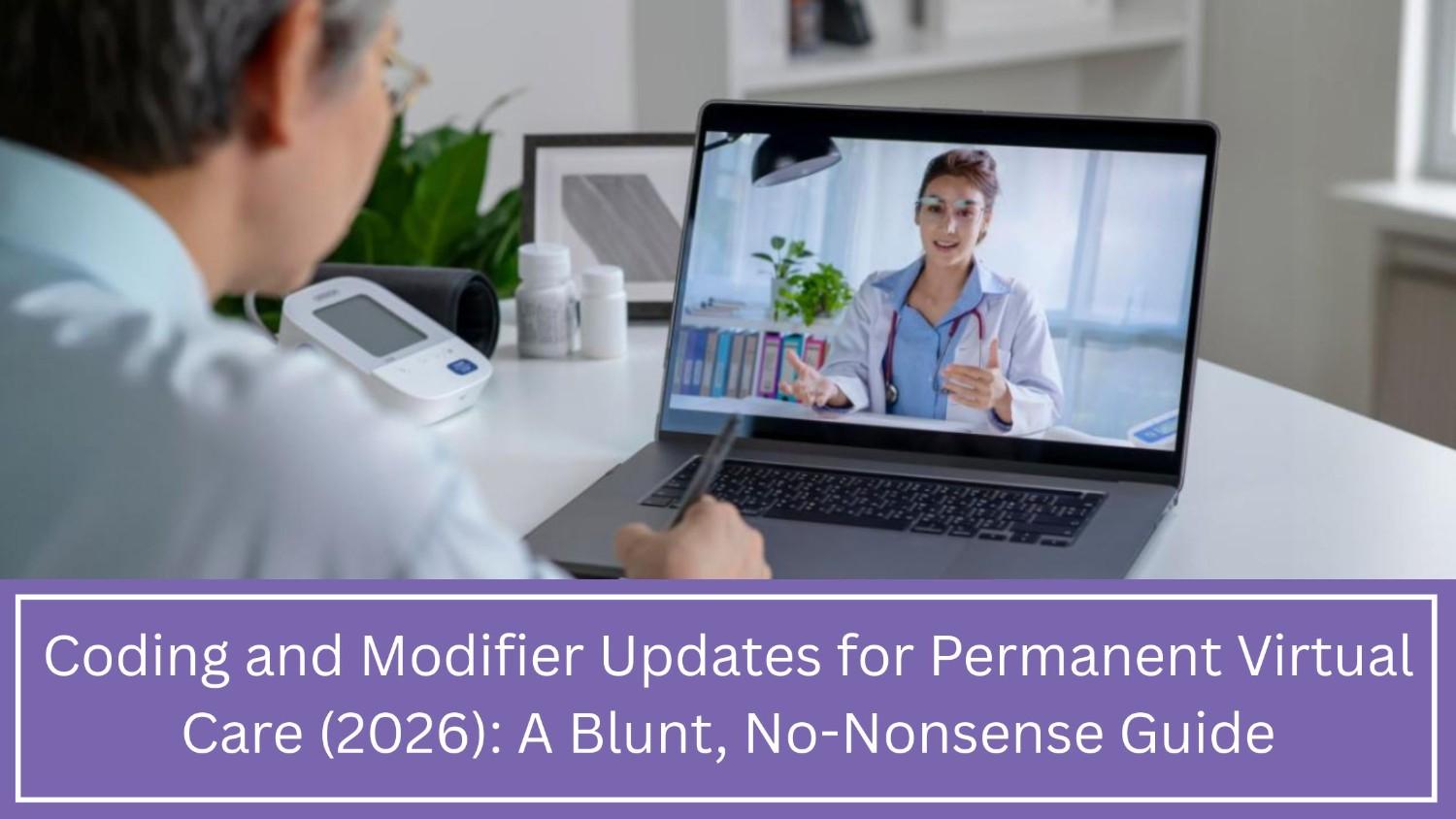
Coding and Modifier Updates for Permanent Virtual Care (2026): A Blunt, No-Nonsense Guide
Virtual care isn’t a trend anymore. It’s infrastructure. CMS locked in permanent telehealth coverage, commercial payers followed with their own rules, and patients now expect hybrid care as the default.
But here’s the truth that most billing teams learn the hard way:
Virtual care doesn’t fail because the service wasn’t medically necessary — it fails because coding wasn’t precise.
Wrong modifier, wrong place-of-service, wrong time requirements, or lazy documentation guarantees denials. And because virtual medical assistant services are touchier than in-person visits, payers scrutinize every line.
This guide spells out what’s changing for 2026, how coding actually needs to look, the modifiers that matter, and the documentation habits that stop denials before they start. No fluff — just the things that move the needle.
1. Virtual Care Is Now Permanent — But the Rules Are Not Static
CMS made telehealth permanent for:
- All mental health services
- Established-patient virtual visits
- Telehealth from the home
- Rural and urban coverage expansion
- FQHC/RHC distant-site medical billing
- Audio-only for selected E/M visits
- Virtual check-ins, e-visits, RPM, and RTM
But “permanent” doesn’t mean “unchanging.”
Each year CMS updates:
- Place-of-service (POS) expectations
- Telehealth originating/distant site requirements
- Eligible providers
- Audio-only allowances
- Time thresholds
- Supervision rules
Fail these rules and you don’t just get denials — you trigger post-pay audits and recoupments.
The smart move is treating virtual-care coding as its own ecosystem instead of forcing in-person logic into it.
2. The Coding Categories You Must Master for Virtual Care
Virtual care isn’t a single service. It covers at least six major coding buckets — each with different requirements, different modifiers, and different payer interpretations.
Here’s the breakdown:
A. Telehealth E/M Visits (99202–99215)
Still the backbone of virtual care.
Key points:
- Time-based medical coding is now the default method for most specialties.
- Medical decision-making (MDM) is allowed but must be clearly supported.
- Audio-only is permitted only for certain visit levels.
B. Virtual Check-ins (G2010, G2012)
Low-level but frequently mis-used.
Payers require:
- Patient-initiated communication
- No E/M visit within 7 days prior
- No E/M visit scheduled within 24 hours/next available slot
Skip these rules and expect denials.
C. Digital E-Visits (99421–99423)
These are online patient portal interactions.
Still MRI-level confusing for many practices.
Key rules:
- Cumulative time over 7 days
- Must be patient-initiated
- Must involve clinical decision-making
D. Remote Physiologic Monitoring (RPM: 99453–99458)
Requires device that transmits automatically, not patient-reported numbers.
Biggest denial triggers:
- Less than 16 days of data
- Missing consent
- Missing supervising provider documentation
E. Remote Therapeutic Monitoring (RTM: 98975–98981)
Covers therapy adherence and musculoskeletal monitoring.
Big pain point:
- Not every payer honors the full RTM suite — commercial plans often modify rules.
F. Interprofessional Consultations (99446–99449, 99451–99452)
These explode in volume every year.
Rules require:
- Requesting provider
- Consulting provider
- No transfer of care
- Documented medical necessity
If your team mixes up e-consults with telehealth E/M, expect instant payer pushback.
3. Modifier Changes You Need to Use Correctly in 2026
Telehealth modifiers are the gatekeepers to payment.
Use the wrong one, and even a perfectly coded service gets kicked out.
Here are the modifier updates that matter:
Modifier 95 — Still the Workhorse
95 = Synchronous telemedicine via real-time audio/video.
2026 clarity:
- Required for all E/M telehealth visits.
- Not used for RPM/RTM or asynchronous reviews.
- Required by most commercial payers and Medicare.
Common mistake:
Using 95 when the visit was audio-only.
That’s an automatic denial under CMS.
Modifier FQ — Audio-Only Telehealth
CMS adopted this permanently for audio-only services.
Examples:
- Certain mental health E/M
- Some low-level established-patient E/M visits
- Patient safety exceptions in rural settings
If you bill audio-only under 95, be prepared for recoupments.
Modifier FR — Split/Shared Services
Applies when both a physician and NPP deliver portions of a telehealth visit.
Still underused but absolutely required in 2026 for hybrid models.
Modifier GT — Legacy Modifier (Payer-Specific)
Medicare no longer requires GT, but certain Medicaid plans and commercial payers still do.
If you act like 95 replaces GT everywhere, you will lose revenue.
Your payer matrix must include GT rules for:
- Medicaid
- Older commercial plans
- Tricare regional carriers
Modifier GQ — Asynchronous Telemedicine
Relevant for:
- Store-and-forward services
- Dermatology image reviews
- Certain radiology-asynchronous consults
Most practices misuse this or skip it entirely.
Modifier CS — Cost-Sharing Waiver (COVID-era)
COVID waivers ended, but some high-risk patients still qualify temporarily under certain programs.
If your team still applies CS broadly, audits will hurt.
4. The New 2026 Modifier Expectations (What Changed This Year)
Payers tightened modifier rules because virtual care exploded.
Here are the 2026 updates affecting you:
A. Commercial payers now require documentation supporting video vs audio-only
If your note says:
“Audio/video visit conducted…”
But the call dropped and you switched to audio-only?
You must update the note.
Payers check this line aggressively.
B. POS 10 (Home) Must Be Paired Correctly
This is one of the most mis-coded virtual care rules.
- POS 10 (Patient home) = Telehealth from home.
- POS 02 (Telehealth) = Anywhere else outside a hospital/office.
If you mix them, payers re-price your claim at lower non-facility rates.
C. RPM/RTM modifiers require time + activity documentation
Payers now demand:
- Start date
- Stop date
- Description of interactive communication
- Who performed the monitoring
Lazy notes get denied instantly.
5. Common Coding Mistakes That Cause Virtual-Care Denials
Let’s call these out bluntly, because every single one is preventable.
Mistake #1 — Using Modifier 95 for everything
RPM? RTM? Portal messages? Remote reviews?
None of these use 95.
Mistake #2 — Forgetting time documentation
Especially 99417 prolonged services.
If the note doesn’t show:
- Total time
- Breakdowns if required
- What you actually did
You won’t get paid.
Mistake #3 — Not proving patient-initiated services
Big problem for:
- Virtual check-ins
- E-visits
If the request didn’t come from the patient, it’s not billable.
Mistake #4 — Wrong POS (02 vs 10)
This one alone costs practices thousands every month.
Mistake #5 — Using E/M codes when the visit didn’t meet E/M criteria
Virtual care doesn’t excuse sloppy MDM.
6. Documentation Requirements That Will Make or Break Payment
If virtual care has a weak spot, it’s documentation.
Payers expect more detail for telehealth than for in-person visits.
Here’s what your documentation must include in 2026:
For Telehealth E/M
- Patient physical location
- Provider physical location
- Type of technology (audio, video, both)
- Patient consent
- Time spent OR MDM details
- Clinical findings
- Assessment & plan
- Follow-up instructions
For Audio-Only
- Reason video was not possible
- Confirmation that patient consented to audio-only
- Time documentation
For RPM/RTM
- Patient consent
- Device details
- Date monitoring began
- Aggregate days of data
- Interactive communications summary
- Who performed the monitoring
For Digital E-Visits
- Patient initiation
- Portal message chain
- Time across the 7-day period
For Interprofessional Consultations
- Requesting provider
- Consulting provider
- Summary of consult
- No transfer of care
If any of these are missing, payers deny instantly — and they’re not wrong.
7. Payer-Specific Rules You Cannot Ignore
This is the part practices underestimate.
“Virtual care” is not consistent across payers.
Examples:
- Some commercial plans do not pay RTM codes at all.
- Some Medicaid plans still require GT instead of 95.
- Some payers require consent every visit — not once per year.
- Some require video-only unless explicitly coded FQ.
- Some downcode telehealth visits automatically unless POS is correct.
Every system needs a Virtual Care Rulebook broken down by:
- Medicare
- Medicaid (state by state)
- Top commercial plans
- Medicare Advantage
- Exchange plans
Use it. Update it every quarter. Train your coding team using it.
It’s the only way to stop custom denials.
8. How to Code the Most Common Virtual-Care Scenarios in 2026
Below are real-world examples with the correct codes, modifiers, and POS.
Scenario 1: 15-minute video E/M visit (established patient)
Code: 99213
Modifier: 95
POS: 10 (if home) or 02 (if elsewhere)
Documentation: Video used, consent, time or MDM.
Scenario 2: Audio-only mental health follow-up
Code: 99213 or 99214
Modifier: FQ
POS: 10
Documentation: Audio-only, reason, consent.
Scenario 3: Remote Physiologic Monitoring — full month
99453 + 99454 + 99457 + 99458
Requirements:
- 16+ days of data
- Interactive communication
- Consent
Scenario 4: Digital E-Visit for 20 cumulative minutes
Code: 99422
POS: 11 or 10 depending on payer
No telehealth modifier for digital codes.
Scenario 5: Interprofessional consult
99451 (written-only request)
99446–99449 (time-based phone consult)
9. What to Fix Immediately if You Want Cleaner Virtual-Care Payments
Here’s the blunt checklist:
Rebuild your telehealth coding cheat sheet
Stop reusing pre-2024 cheat sheets — they’re outdated and guaranteed to cause denials.
Standardize POS 02 vs POS 10
One mistake here destroys reimbursement rates.
Create a modifier matrix and train staff
Especially 95, FQ, FR, GT, GQ.
Separate audio-only vs audio/video workflows
They have completely different rules.
Make consent collection automatic
Tie it into intake templates or EHR macros.
Audit your RPM/RTM programs every month
Payers are cracking down hard.
Build a payer-specific rulebook
Because no two plans treat virtual care the same.
Stop relying only on MDM for virtual care
Time-based coding is safer, cleaner, and harder for payers to dispute.
10. Final Takeaway: Virtual Care Is Permanent — but Payment Isn’t Guaranteed
Virtual care isn’t the problem.
Coding sloppiness is.
If you want accurate reimbursement:
- Use the correct modifiers
- Nail POS rules
- Document thoroughly
- Know your payer requirements
- Audit your virtual visits weekly
- Train clinicians on time documentation
The practices that take virtual care seriously are getting paid on time.
The ones that copy-paste old rules are drowning in denials.
Make virtual care a structured, disciplined service line — not an afterthought.

ALSO READ – Simplifying Revenue Management: How Medical Billing Services Empower Small Practices
Talk to Medical Billing Expert Today — Get a Free Demo Now!