
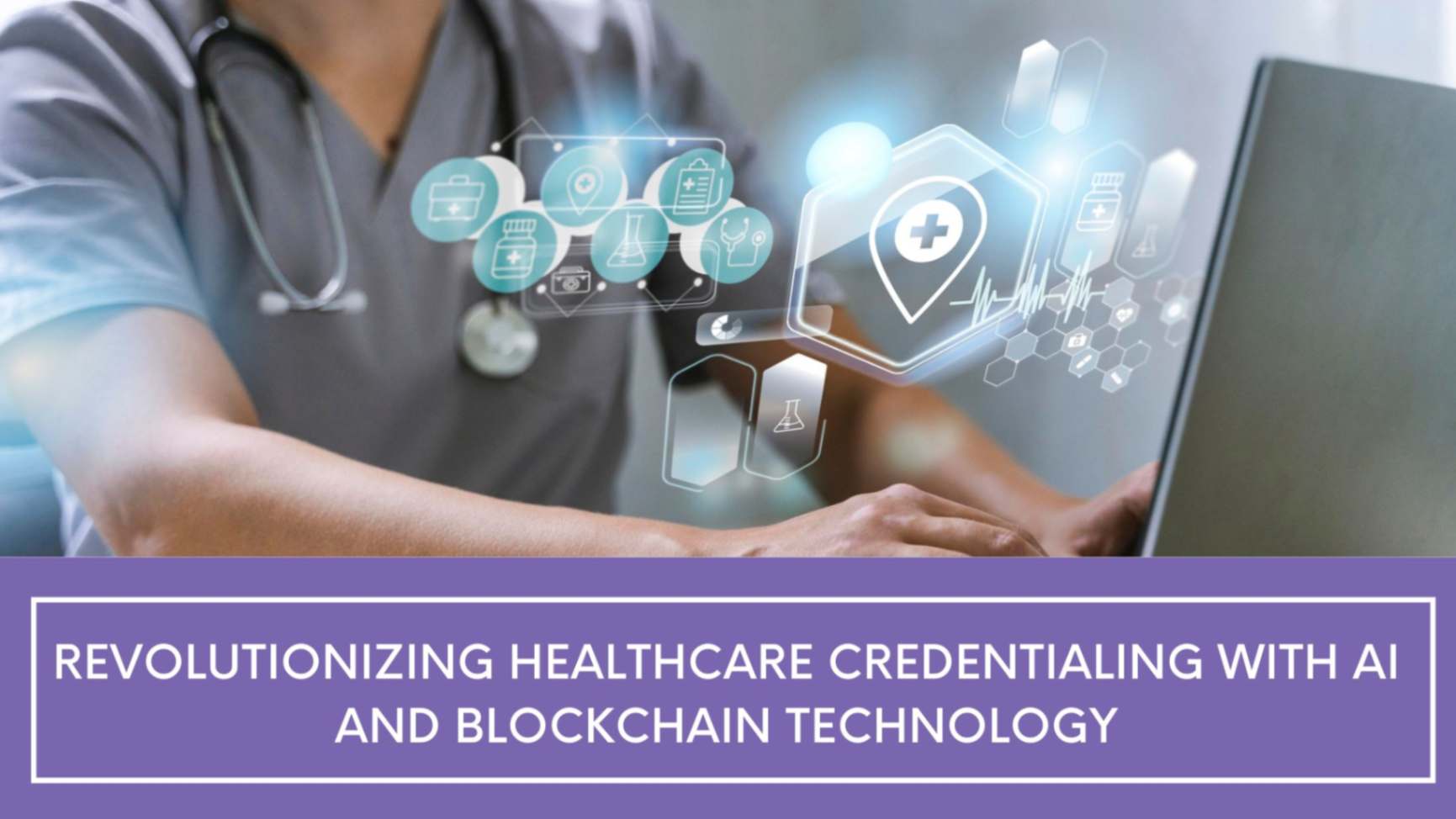
Revolutionizing Healthcare Credentialing with AI and Blockchain Technology
The process of healthcare credentialing is experiencing a complete revolution as both AI and blockchain technology transform the process of provider credentialing in the health sector. Conventional credentialing has been associated with the process of paperwork, repeated documentation, and constant communication with payers, which ends up delaying the process and consequently impacts both patient care and financial gain. Modern-day credentialing powered by AI and blockchain for medical credentialing. This brings in a faster, more secure, and fully automated view to healthcare provider verification.
Through the use of intelligent automation and tamper-proof digital documentation, healthcare organizations can benefit by reducing the burden of administrative functions, speeding up the process of credentialing, and improving compliance. Credentialing technologies allow physicians to be able to practice more quickly, as well as provide efficiency within the organization.
Key advantages include the following:
- Faster provider verification
- Reduced credentialing backlog
- Improved data accuracy
- Stronger security
- Better compliance monitoring
- Automated workflows
- Enhanced provider experience
CTA Button: Modernize Your Credentialing Process
Table of Contents
The Hidden Cost of Traditional Healthcare Credentialing
Traditional healthcare credentialing is usually slow, manual, and prone to mistakes. Staff spend too much time chasing documents, verifying sources, and calling boards or insurance companies. One small error can stall a provider’s start date for weeks, which hurts patient care and stops payments from coming in. Now, a lack of staff and stricter rules only make these bottlenecks harder to manage.
As provider lists grow and online care expands, doing credentialing by hand no longer works. Companies that stick to paper waste more money, take longer credentialing turnaround time, and miss out on new income.
Common challenges include:
- Manual document collection
- Duplicate data entry
- Delayed payer enrollment
- Credentialing backlogs
- Increased administrative costs
- Higher compliance risk
- Slower provider onboarding
CTA Button: Reduce Credentialing Delays
Why Manual Credentialing Slows Provider Onboarding
Every step of old credentialing is manual work. You have to gather licenses and call sources to check them. When many teams and payers are involved, things slow down. Providers then wait months before they can see patients or get reimbursed for their services.
Manual bottlenecks include the following:
- Paper-based applications
- Repeated data entry
- Email-based communication
- Slow verification processes
- Limited workflow visibility
CTA Button: Accelerate Provider Enrollment
Financial Impact of Credentialing Delays
Credentialing delays do more than slow you down—they cost you money. Every day a provider isn’t cleared means lost visits, late payments, and fewer patients seen. Your teams also spend too much time and cost just trying to fix the backlog.
Potential business impacts:
- Lost patient revenue
- Delayed payer reimbursement
- Lower provider productivity
- Increased administrative expenses
- Poor patient experience
CTA Button: Protect Practice Revenue
How AI Is Transforming Healthcare Credentialing
AI is changing the landscape of credentialing through automation of repetitive administrative processes along with increased efficiency and accuracy. AI-powered credentialing can pull information from applications, validate documentation, detect missing documents, prioritize incomplete tasks, and track document expiry dates without any human involvement. Credentialing professionals would only have to deal with exceptions and challenging situations.
AI is useful in automating provider credentialing in terms of identifying any gaps in the application before submission. In combination with payer enrollment automation, AI assists organizations in increasing efficiency as well as reducing turnaround time for credentialing.
AI capabilities include:
- Intelligent document processing
- Automated verification workflows
- Expiration monitoring
- Missing document detection
- Predictive workflow management
- Credentialing backlog reduction
- Automated compliance tracking
CTA Button: Explore AI-Powered Credentialing
AI Improves Accuracy and Compliance
Artificial intelligence cuts down mistakes by checking provider info against trusted sources. Smart workflows make sure all documents are ready before you send them, while tracking expiration dates and rules to keep you compliant.
AI helps organizations:
- Reduce human error
- Improve data consistency
- Monitor compliance automatically
- Detect incomplete applications
- Support audit readiness
CTA Button: Improve Credentialing Accuracy
Blockchain: The Game-Changer for Transparency and Security
Although AI is helping with credentialing processes, blockchain technology for medical credentialing ensures greater trustworthiness, transparency, and secure storage of data. Blockchain establishes a decentralized digital ledger system in which verified credentials of the provider can be stored and exchanged without any tampering. After credentials are verified via healthcare provider verification, they cannot be tampered with.
Instead of checking the same licenses and degrees over and over, health teams can use one trusted digital record. This cuts out busy work and stops double entries while keeping data safe and helping providers work better together.
Blockchain benefits include:
- Secure credential storage
- Tamper-resistant records
- Faster provider verification
- Reduced duplicate verification
- Greater transparency
- Improved interoperability
- Enhanced data integrity
CTA Button: Discover Blockchain Credentialing
Why Blockchain Builds Trust in Credentialing
Credentialing depends on facts you can trust. Blockchain stops records from being changed without permission, so hospitals and insurers can rely on the data. This also lets providers decide exactly who sees and uses their verified credentials.
Blockchain advantages:
- Immutable credential records
- Secure information sharing
- Faster verification
- Reduced fraud risk
- Improved provider trust
CTA Button: Secure Your Credentialing Data
The AI + Blockchain Synergy
Whereas individually both AI and blockchain have their own benefits, the integration of the two makes an advanced credentialing system. Credentialing powered by AI involves automation of document collection and workflow management. The blockchain medical credentialing technology, on the other hand, ensures that there is immutability when storing credentials of the verified providers. Collectively, these technologies help minimize human interaction, accelerate credentialing turnaround time, and foster trust among hospitals, payers, and providers.
While artificial intelligence evaluates applications, identifies discrepancies, and ranks high-priority actions, blockchain ensures that credentials are secured and shareable. An innovative solution such as this allows for automating the provider credentialing process, decreasing credentialing backlog, and streamlining the process of onboarding providers.
The combined benefits include the following:
- Faster provider onboarding
- Secure credential sharing
- Reduced verification delays
- Improved compliance
- Lower administrative costs
- Greater workflow visibility
- Enhanced provider experience
CTA Button: Experience Smarter Credentialing
Traditional Credentialing vs. AI + Blockchain Credentialing
Healthcare organizations moving to digital tools often compare old ways of checking credentials with new tech. Manual work depends too much on emails, spreadsheets, paper, and repeated verification requests.
AI and blockchain fix this by handling boring tasks and creating secure records that stop repeat work. This leads to faster approvals, fewer mistakes, and better compliance.
|
Traditional Credentialing |
AI + Blockchain Credentialing |
|
Manual document collection |
Automated document processing |
|
Repeated provider verification |
Single trusted digital verification |
|
Paper-based workflows |
Digital credentialing platform |
|
Longer turnaround times |
Faster provider onboarding |
|
Higher administrative costs |
Greater operational efficiency |
|
Limited visibility |
Real-time workflow tracking |
|
Higher error rates |
Improved data accuracy |
CTA Button: Upgrade Your Credentialing Workflow
Why Practolytics Is the Right Credentialing Partner
Practolytics combines expert staff with smart tools to help healthcare groups handle provider enrollment and compliance. Our team manages every step—from verifying sources and payer setup to regular checks and renewals—using automation to stop delays.
Whether you are hiring one provider, expanding a multi-specialty practice, or running hospital credentialing services, we provide a fit that grows with you. Our process makes work clearer, cuts down on paperwork, and lets your providers start seeing patients faster.
Why healthcare organizations choose Practolytics:
- AI-assisted credentialing workflows
- End-to-end payer enrollment support
- Credentialing compliance expertise
- Faster turnaround times
- Transparent reporting
- Dedicated credentialing specialists
- HIPAA-compliant processes
CTA Button: Start Credentialing with Practolytics
Business Benefits of AI and Blockchain in Credentialing
In addition to increasing efficiencies, AI and blockchain add value to healthcare organizations. AI-driven workflows result in lower staffing needs, quick provider onboarding, and quick payer onboarding; all of this allows the organization to make money faster. Blockchain creates trust among providers, hospitals, and insurance companies through secure and verified credentialing documentation.
The use of these technologies not only helps in meeting regulatory requirements but also results in saving money due to fewer administrative expenses linked to the repetitive process of verification. As the network in healthcare keeps growing, using intelligent credentialing technology becomes increasingly important.
Business benefits include the following:
- Reduced credentialing costs
- Faster revenue generation
- Lower compliance risk
- Improved provider satisfaction
- Better scalability
- Reduced credentialing backlog
- Enhanced operational efficiency
CTA Button: Transform Your Credentialing Operations
What’s Next: Emerging Trends in Credentialing Technology
Digital healthcare credentialing is still changing, as organizations adopt automation, integration, and predictive analytics. Future digital credentialing systems will leverage more technology, such as artificial intelligence, blockchain, cloud computing, and real-time regulatory compliance, to streamline provider validation processes. Predictive AI can foresee the credentialing challenges that may arise, while blockchain technology-enabled digital credentials may enable providers to exchange validated information with different hospitals and payer networks without going through the verification process.
The improvement of interoperability among credentialing systems, EHRs, and enrollment programs for payer networks will only add to the decreased administrative burden and increased portability of providers. Entities that embrace these technologies now will have an easier time dealing with the challenges of tomorrow.
Emerging trends include:
- Predictive credentialing analytics
- Digital provider identity
- Real-time compliance monitoring
- Cloud-based credential repositories
- Intelligent workflow automation
- Multi-state credential portability
- Expanded payer integration
CTA Button: Future-Proof Your Credentialing Strategy
Conclusion: Build a Faster, Smarter Credentialing Process
The way forward for credentialing in healthcare will be through the integration of intelligent automation and secure digital infrastructure. AI-powered credentialing makes the process faster, cuts down on paperwork, and increases compliance, while blockchain-based medical credentialing brings in transparency and data security.
All of these together contribute to the ability of organizations to reduce turnaround time for credentialing, cut down administrative expenses, and onboard providers efficiently without compromising security and regulatory compliance. Healthcare organizations that collaborate with Practolytics will be able to work with expert credentialing specialists as well as advanced automated solutions.
Frequently Asked Questions
1. What is AI-powered healthcare credentialing?
AI-powered healthcare credentialing is a technology that makes use of artificial intelligence in order to perform routine tasks such as collecting documents, verifying the primary sources, reviewing applications, monitoring the expiry process, and more.
2. How does blockchain improve provider credentialing?
Blockchain medical credentialing technology entails keeping authenticated credentials of providers in a safe and immutable digital ledger. Hospitals, payers, and providers authorized to use the system can get access to their credential information without verifying it again.
3. Are AI and blockchain credentialing solutions HIPAA-compliant?
Yes. When used effectively, AI and blockchain systems can help with HIPAA compliance through encryption, role-based access control, audit trails, and data management. Additionally, organizations should consider making sure that their vendors adhere to relevant healthcare standards.
4. How long does AI + blockchain credentialing take compared to traditional methods?
While timelines vary by payer and provider, AI and blockchain speed up credentialing by cutting out manual work and making document verifications faster.
5. What is a smart contract in the context of credentialing?
A smart contract is a digital agreement on a blockchain that triggers actions automatically when a goal is hit. In credentialing, these tools handle check-ups, send alerts, and renew licenses without manual work.
6. Can AI reduce credentialing errors?
Yes. AI catches missing forms, wrong provider data, and missing credentials before you hit send. This cuts down on human error and helps you get approved the first time.
7. Does blockchain credentialing help with multi-state or telehealth providers?
Yes. Blockchain lets health groups share proven records safely. This makes it easier to handle state licenses, grow telehealth, and check credentials across different networks.
8. What’s the difference between credentialing and re-credentialing?
Credentialing checks a provider’s skills before they start. Re-credentialing is the regular check of licenses and history to ensure they still meet the rules and payer standards.
9. Is AI and blockchain credentialing only for large hospital systems?
No. All healthcare organizations can make use of automation and a secure digital credential management system regardless of their size, including small independent clinics, specialty facilities, ASCs, and physicians’ practices.
10. How do I get started with AI and blockchain-powered credentialing?
First, you should assess your current process of credentialing, pinpoint areas where the process is bottlenecked manually, and choose a reliable credentialing company that provides automation and technology solutions.
CTA Button: Talk to a Credentialing Expert
Why Practolytics?
- AI-enabled credentialing workflows
- Faster provider onboarding
- Secure, compliant processes
- Reduced credentialing backlogs
- End-to-end payer enrollment support
- Transparent reporting and analytics
CTA Button: Request a Free Credentialing Consultation
ALSO READ – Charting the Future: Navigating 2024’s Healthcare Credentialing with Practolytics
Talk to Medical Billing Expert Today — Get a Free Demo Now!